Pinyin: Tumuxiang
Aliases
Qingmuxiang, Qimuxiang, Zangmuxiang
Source
Asteraceae plant, Inula heleniumInula heleniumL.'s dried root.
Botanical Description
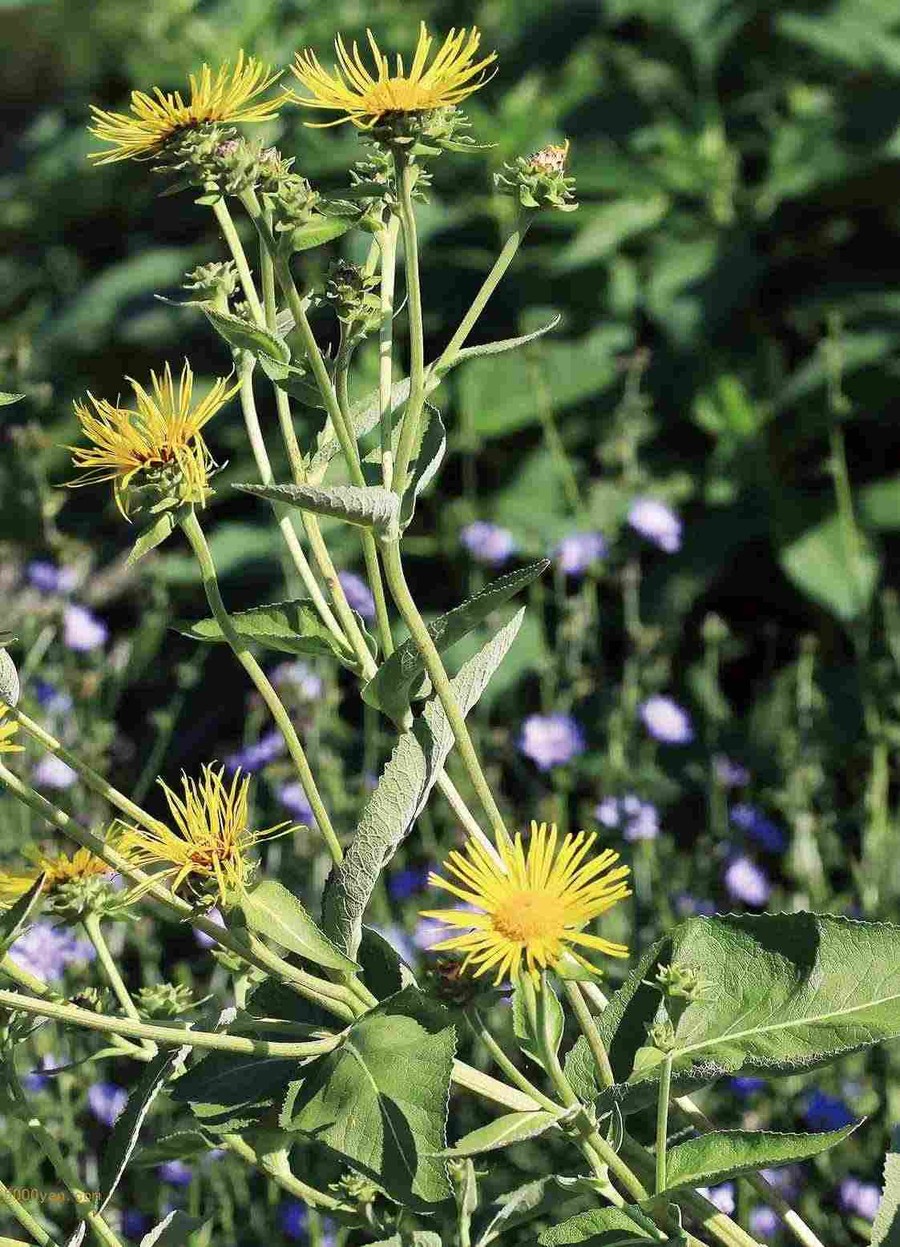
Perennial herb, 60-150 cm tall, up to 250 cm. Rhizome tuberous, branched. Stem erect, stout, up to 1 cm in diameter, unbranched or branched above, covered with spreading long hairs. Leaves at base sparse, base gradually narrowed into winged petiole up to 20 cm long; leaf blade elliptic-lanceolate, 10-40 cm long, 10-25 cm wide, apex acute, margin irregularly toothed or double-toothed, upper surface with basally verrucose scabrous hairs, lower surface densely yellow-green pubescent, veins slightly raised beneath, reticulate veins distinct; middle leaves ovate-lanceolate or oblong, smaller, base cordate, semi-amplexicaul; upper leaves lanceolate, small. Capitula few, 6-8 cm in diameter, arranged in corymbose or racemose inflorescences; peduncles very short to 12 cm long, surrounded by numerous bracts; involucre 5-6 series, outer layer leathery, broad-ovate, apex obtuse, often reflexed, pubescent, 6-9 mm wide; inner layer oblong, apex expanded into ovate-triangular, dry membranous, sparsely hairy on back, ciliate, 3 times longer than outer layer; innermost linear, apex slightly expanded or narrowly acute; ray florets yellow, ligule linear, 2-3 cm long, 2-2.5 mm wide; disc florets about 9-10 mm long, with lanceolate lobes; pappus dirty white, 8-10 mm long, with numerous finely toothed hairs. Achenes 4- or 5-angled, 3-4 mm long, glabrous. Flowering period June-September.
Habitat and Distribution
Grows along riverbanks, field edges, and other damp areas. Distributed in Northeast, North, and Northwest China; cultivated in Hebei, Shanxi, Zhejiang, Henan, Hubei, and Sichuan.
Harvesting and Processing
Harvested in autumn, dug out, remove sediment and sand, and sun-dry.
Medicinal Properties
This product is conical in shape, slightly curved, 5-20 cm long. The surface is yellow-brown or dark brown, with longitudinal wrinkles and rootlet scars. The root head is thick and large, with a depressed stem scar at the apex and remains of leaf sheaths, surrounded by cylindrical branch roots. The texture is hard, not easily broken; the cut surface is slightly flat, yellow-white to light gray-yellow, with punctate oil cavities. The odor is faintly aromatic; the taste is bitter and acrid.
Chemical Constituents
This product mainly contains components such as inulin, volatile oil, alantolactone, isoalantolactone, alantic acid, and alantol.
Pharmacology
Has insecticidal and antibacterial effects; also has certain effects on the heart, blood pressure, blood flow, and smooth muscles.
Properties and Channel Entry
Acrid, bitter, and warm. Enters the Liver and Spleen channels.
Functions and Indications
Tonifies the Spleen and harmonizes the Stomach, moves Qi and alleviates pain, and calms the fetus
Dosage and Administration
Oral administration: decocted in water, 3-9 g, often taken in pill or powder form.
Precautions and Contraindications
Patients with blood deficiency and internal heat should use with caution.
Prescriptions
1. For stomach pain: 3 g of Inula helenium, 15 g of Corydalis yanhusuo. Grind into powder, take with water, 2 times daily. (Shanxi Chinese Herbal Medicine) 2. For chest, rib, and stomach distension and pain: 9 g each of Inula helenium, Pogostemon cablin, Citrus aurantium, and Citrus reticulata. Decoct in water for oral administration. (Shanxi Chinese Herbal Medicine) 3. For diarrhea with borborygmus: Equal amounts of Inula helenium and Coptis chinensis. Grind into powder, take 2-3 g each time with boiling water. (Hubei Chinese Herbal Medicine Record) 4. For bacillary dysentery: 9 g each of Inula helenium and Coptis chinensis. Decoct in water for oral administration. (Hebei Chinese Herbal Medicine) 5. For toothache: Appropriate amount of Inula helenium. Mash or chew, apply to the affected area or insert into the cavity of a decayed tooth. (Hubei Chinese Herbal Medicine Record) 6. For intercostal neuralgia: 9 g each of Inula helenium and Curcuma aromatica. Decoct in water for oral administration. (Hebei Chinese Herbal Medicine)