Pinyin: Shanglu
Aliases
Jianzhongxiao, Xiashanhu, Tumuji.
Source
Phytolaccaceae plant Phytolacca acinosa Roxb.Phytolucca acin0saRoxb. or *Phytolacca americana* L.Phytolacca americanaL.'s dried root.
Botanical Description
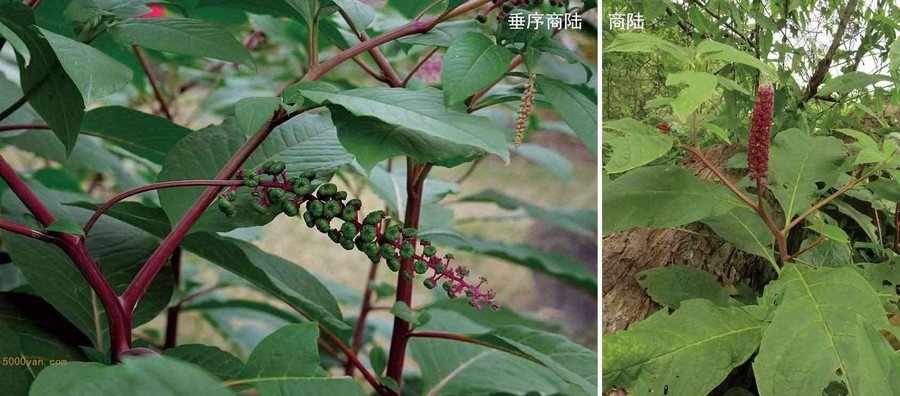
1. Shanglu (Phytolacca acinosa): Perennial herb, up to 1.5 m tall. Entire plant glabrous (hairless). Root thick, conical, fleshy, outer bark pale yellow with transverse lenticels, with many lateral roots. Stem green or purplish-red, much branched. Leaves simple, alternate, petiolate; petiole base slightly flattened and broad; leaf blade ovate-elliptic or elliptic, 12-15 cm long, 5-8 cm wide, apex acute or acuminate, base gradually narrowed, margin entire. Racemes terminal or axillary, erect; perianth segments 5, initially white then gradually turning pale red; stamens 8-10; carpels 8-10, separate but closely appressed. Berry, oblate, with persistent calyx, ripening to deep reddish-purple or black; seeds reniform, black. Flowering and fruiting period: May-October. 2. Chuixu Shanglu (Phytolacca americana): Perennial herb, up to 1.5 m tall. Entire plant glabrous (hairless). Root thick, conical, fleshy, outer bark pale yellow with transverse lenticels, with many lateral roots. Stem purplish-red, much branched, with prominent angles. Leaves simple, alternate, petiolate; petiole base slightly flattened and broad; leaf blade ovate-elliptic or elliptic, margin entire, shape narrower. Racemes terminal or axillary, drooping; perianth segments 5, initially white then gradually turning pale red; stamens and carpels usually 10, separate but closely appressed. Berry, oblate, with persistent calyx, ripening to deep reddish-purple or black; seeds reniform, black. Flowering period: July-August, fruiting period: August-October.
Habitat and Distribution
1. Shanglu: grows by roadsides in sparse forests or is cultivated in gardens; distributed throughout most regions of China. 2. Chuixu Shanglu: grows in forests, by roadsides, and in damp, shady areas near houses; distributed in Shaanxi, Hebei, Jiangsu, Shandong, Zhejiang, Jiangxi, Hubei, Guangxi, Sichuan, and other areas.
Harvesting and Processing
Harvested in autumn until the following spring, remove the fibrous roots and soil. Cut into pieces or slices, then sun-dry or dry in the shade.
Medicinal Properties
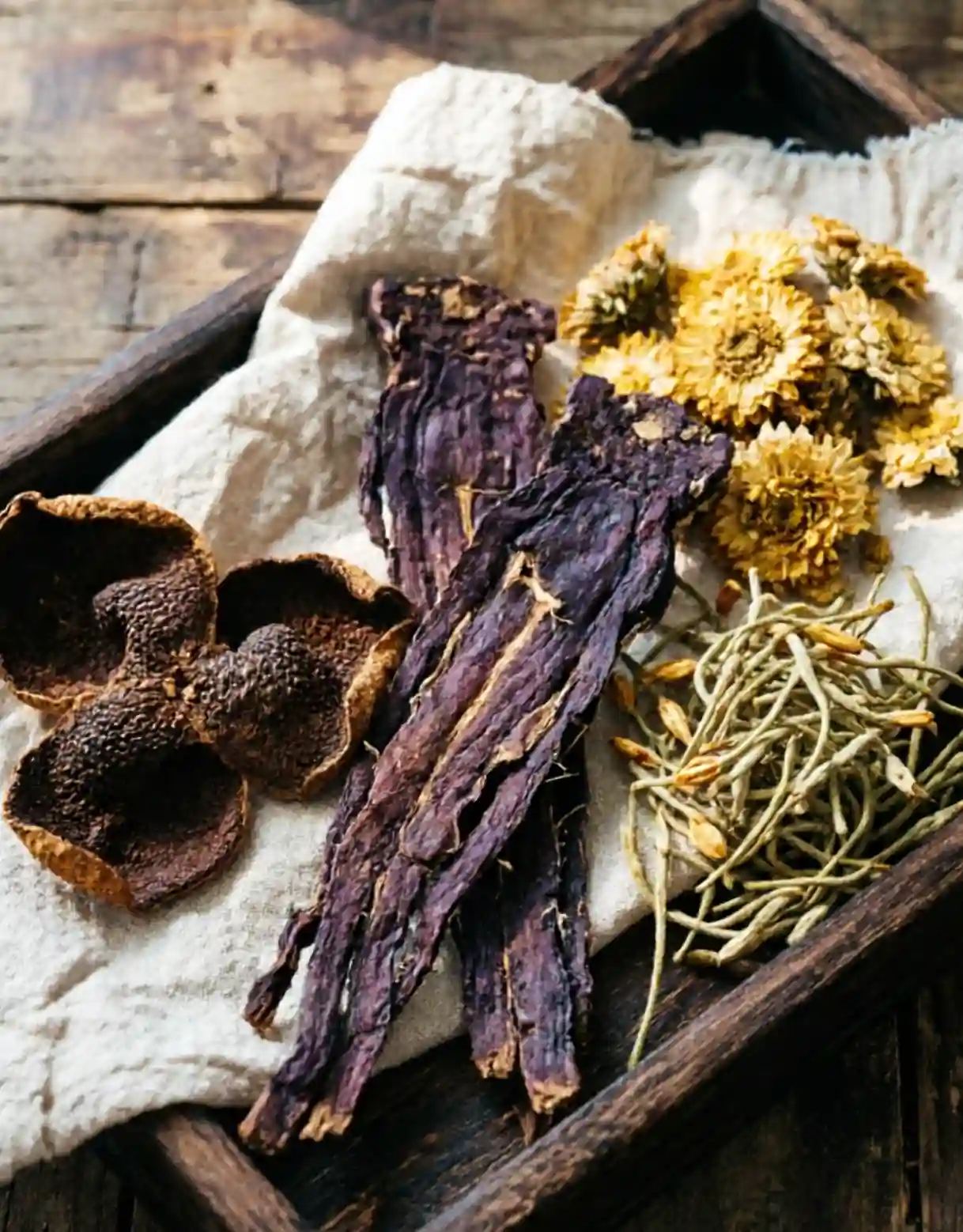
This product consists of irregular transverse or longitudinal slices of varying thickness. The outer bark is grayish-yellow or grayish-brown. Transverse slices are curved and uneven, with wrinkled edges, diameter 2-8 cm; the cut surface is light yellowish-brown or yellowish-white, with raised wood portions forming several prominent concentric rings. Longitudinal slices are curved or curled, 5-8 cm long, 1-2 cm wide, with the wood portion showing parallel strip-like protrusions. The texture is hard. Odor: faint; Taste: slightly sweet, with a numbing sensation on the tongue after prolonged chewing.
Chemical Constituents
This product contains phytolaccasaponin A, phytolaccasaponin B, phytolaccasaponin C, phytolaccasaponin D, phytolaccasaponin A (esculentoside A), phytolaccagenic acid, phytolaccagenin, 2-hydroxyphytolaccagenic acid, pokeweed antiviral protein, pokeweed mitogen E, and phytolaccasaponin and other constituents.
Pharmacology
Enhances immune function; has anti-inflammatory, antibacterial, antiviral, antitumor, antitussive, expectorant, antiasthmatic, diuretic, and anti-gastric ulcer effects, promotes DNA and RNA synthesis, and inhibits the central nervous system and heart.
Properties and Channel Entry
Bitter, cold; toxic. Enters the Lung, Spleen, Kidney, and Large Intestine channels.
Functions and Indications
Expels water and reduces swelling, promotes urination and bowel movement; for external use, resolves toxicity and dissipates nodules. Used for edema and abdominal distension, difficulty in urination and defecation; externally used for carbuncles, swellings, sores, and toxins.
Dosage and Administration
Oral: Decoct 3-10 g in water; or taken as powder
Precautions and Contraindications
Use with caution in cases of edema due to deficiency; contraindicated during pregnancy. Begin with a small dose. This product is irritating to the gastrointestinal tract, so it should be taken after meals. Overdose poisoning may manifest as nausea and vomiting, abdominal pain and diarrhea, tachycardia, tachypnea, followed by slurred speech, agitation, convulsions; in severe cases, hypotension, coma, dilated pupils, and death due to cardiac or respiratory arrest.
Prescriptions
1. For falls and contusions: Grind *Phytolacca acinosa* (Shanglu) root into powder, mix with warmed wine and apply to the bruised and darkened areas; applying a plaster over the area yields better results. (from *Diannan Bencao*) 2. For peptic ulcer: Mix 10 g of *Phytolacca acinosa* powder, 10 g of *Crinis Carbonisatus* (charred human hair), and 1 fresh egg. Remove the eggshell, blend the egg white and yolk thoroughly with the powders. Heat a small amount of tea oil in a pan until hot, then pour the mixture in and fry until cooked. Take orally twice daily (once in the morning and once in the afternoon), with 2 weeks constituting one course of treatment. [from *Hunan Journal of Traditional Chinese Medicine*, 1985, (4):13] 3. For dysfunctional uterine bleeding: Simmer 60-120 g of fresh *Phytolacca acinosa* root with 250 g of pork; eat the meat and drink the broth. (from *Shennongjia Chinese Medicinal Herbs*) 4. For edema and dysuria: Pound *Phytolacca acinosa* root into a paste, mix with 0.9 g of musk, and apply to the navel, securing it with a cloth. Once urination becomes smooth, the swelling will subside. (from *Compendium of Materia Medica*)