Pinyin: Banlangen
Aliases
Dianqinggen, Landiangen.
Source
Botanical family Brassicaceae, plant *Isatis indigotica* Fort.Isatis indigoticaFort. dried root.
Botanical Description
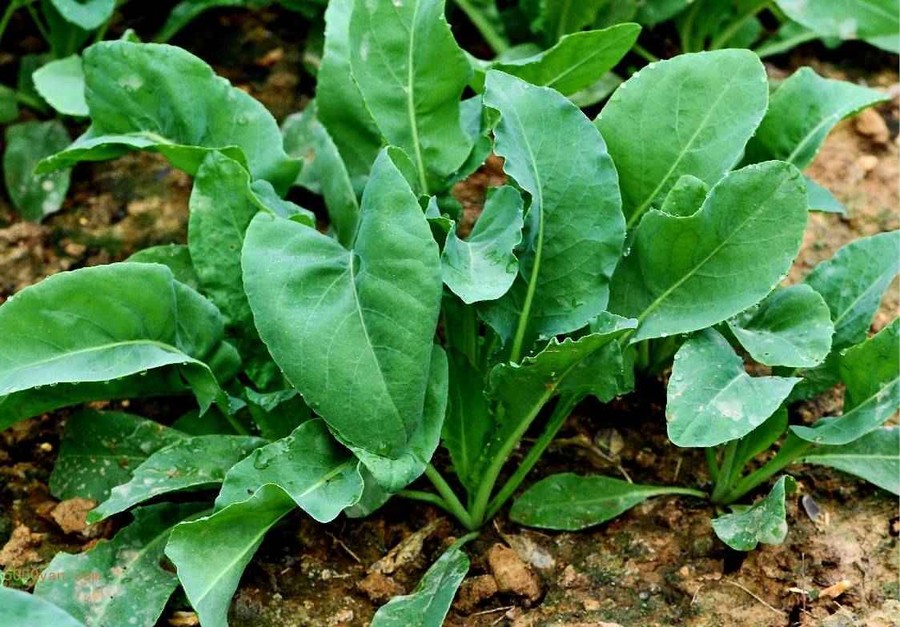
Biennial herb, plant height 50-100 cm. Glabrous (hairless), often with a powdery bloom. Root thick, nearly conical, surface earthy yellow, with short transverse wrinkles and a few fibrous roots. Basal leaves rosulate, leaf blade oblong to broadly oblanceolate, 5-15 cm long, 1.5-4 cm wide, apex obtuse-acute, margin entire or slightly undulate-dentate, with rounded auricles or indistinct; upper stem leaves broadly linear, entire, sessile. Racemes terminal or axillary, forming a panicle at branch tips; sepals 4, broadly ovate or broadly lanceolate; petals 4, yellow, broadly cuneate, apex nearly truncate, margin entire, base with indistinct short claw; stamens 6, 4 long and 2 short; pistil 1, ovary nearly cylindrical, style boundary indistinct, stigma truncate. Silicle nearly oblong, flattened, glabrous, margin with membranous wings, especially broader at both ends, valves with a midvein. Seeds 1, oblong, light brown. Flowering period April to May, fruiting period May to June.
Habitat and Distribution
Originally produced in China, now cultivated in various regions.
Harvesting and Processing
Harvested in autumn, dug out, remove sediment and sand, and sun-dry.
Medicinal Properties
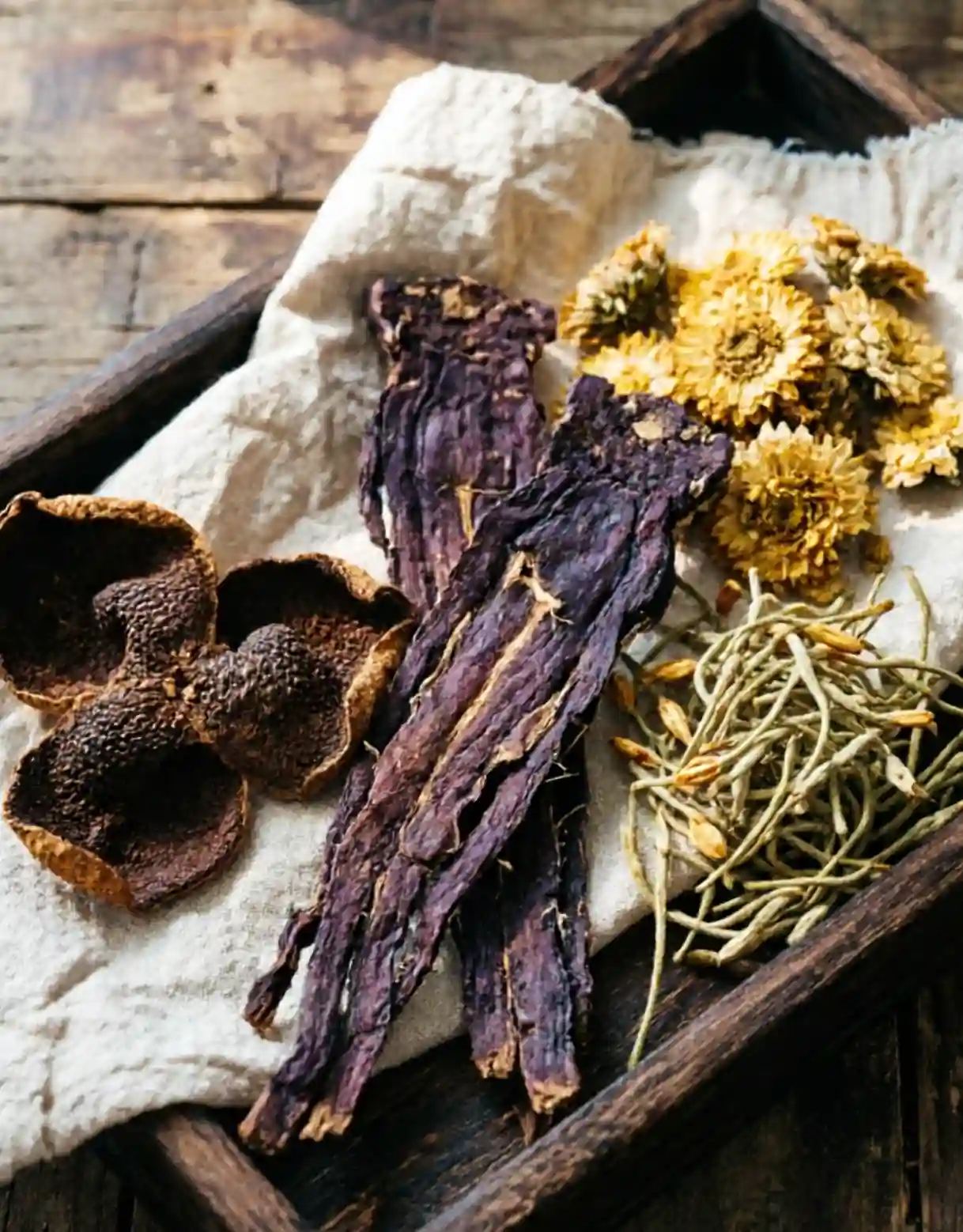
Root cylindrical, slightly twisted, 10-20 cm long, 0.5-1 cm in diameter. Surface pale grayish-yellow or pale brownish-yellow, with longitudinal wrinkles and transverse lenticels, and remains or scars of rootlets; root crown slightly expanded, with visible whorled remains of dark green or dark brown petiole bases, petiole scars, and dense warty protrusions. Texture firm, slightly soft; fracture nearly flat, with a yellowish-white bark occupying 1/2 to 3/4 of the radius and a yellow wood. Odor: faint; Taste: slightly sweet, followed by bitter and astringent.
Chemical Constituents
This product contains (R,S)-goitrin, epigoitrin, indigo, indirubin,β- β-sitosterol, lupeol, acteoside, chrysophanol, etc.
Pharmacology
Has antibacterial, antiviral, anti-endotoxin, anticancer, and immune-enhancing regulatory effects.
Properties and Channel Entry
Bitter, cold. Enters the Heart and Stomach channels.
Functions and Indications
Clears Heat and resolves toxicity, cools the Blood and benefits the throat
Dosage and Administration
Oral: decoct 15-30 g, large doses of 60-120 g may be used; or made into pills or powder. External use: appropriate amount, decoct for steaming and washing.
Precautions and Contraindications
Patients with Spleen and Stomach deficiency-cold and without actual Heat-toxin should use with caution.
Prescriptions
1. For epidemic encephalitis type B, mild or moderate type: Banlangen 30 g, Daqingye 15 g, Yinhua 15 g, Lianqiao 15 g, Xuanshen 15 g, Shengdi 30 g, Shengshigao (decocted first) 30 g, Huangqin 12 g, Gandilong 9 g. Decoct in water and take orally. (Banlangen Daqing Decoction, from "Clinical Application of Chinese Herbal Medicine" by Zhongshan Medical College) 2. For epidemic cerebrospinal meningitis: Banlangen 125 g. Decoct in water and take orally once every 2 hours. (from "Shanxi Chinese Herbal Medicine") 3. For hepatitis: Banlangen and Yinchen each 15 g, Chishao 9 g, Gancao 3 g. Decoct in water and take orally. For elevated transaminase levels, add Xiakucao 6 g. (from "Xinjiang Chinese Herbal Medicine") 4. For pneumonia: Banlangen and Xiakucao each 15 g, Huzhang 30 g, Gonglaoye 12 g, Yinhua 9 g, Qinghao 9 g. Decoct in water and take orally. (from "Hubei Chinese Herbal Medicine Journal") 5. For mumps: Banlangen 15 g, decoct in water and take orally. Squeeze the dregs to extract juice and apply to the affected area. (from "Shanxi Chinese Herbal Medicine")