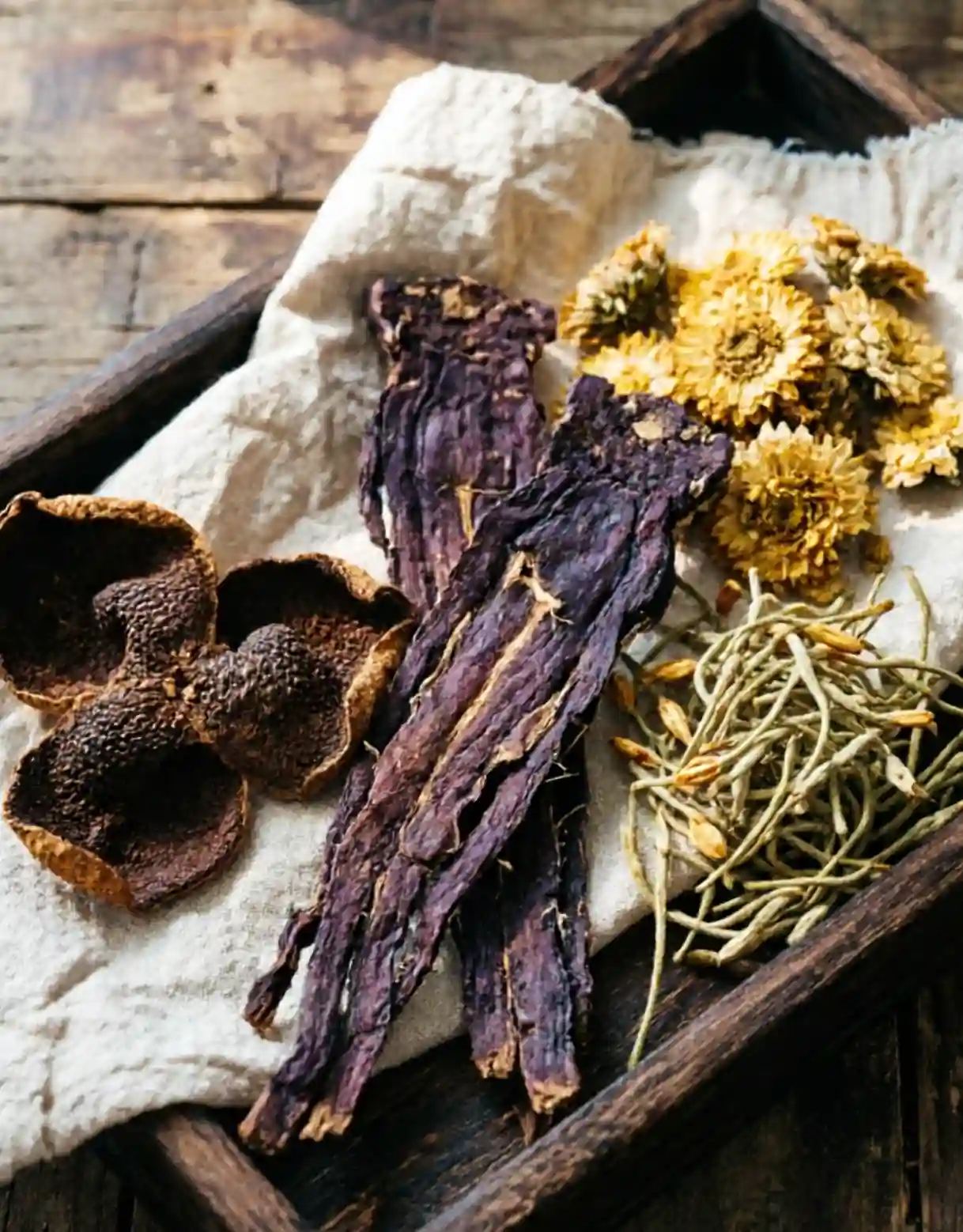
Pinyin: Yujin
Aliases
Wudizu, Huangyu, Wutou.
Source
1. For pneumonia: Renshen 6 g, decoct in water and take orally.Curcuma wenyujinDried root tuber of Y.H.Chen et C.Ling.
Botanical Description
A perennial herb, 80-160 cm tall. The main rhizome is turbinate (top-shaped), lateral rhizomes are finger-like, with a lemon-yellow interior. The fibrous roots are slender, with the terminal ends often swelling into fusiform root tubers with a white interior. Leaves are 4-7, arranged in two rows; petioles are short, less than half the length of the leaf blade; leaf blades are broadly elliptic, apex acuminate to short caudate-acuminate, base cuneate, decurrent onto the petiole, glabrous abaxially. Staminate inflorescence is cylindrical, emerging from the rhizome before the leaves, 20-30 cm long, 4-6 cm in diameter; the upper, sterile bracts are long-elliptic, rose-red; the middle and lower, fertile bracts are broadly ovate, greenish-white. The calyx tube is white, with an apex bearing 3 unequal teeth; the corolla tube is funnelform, white, with 3 lobes, membranous, long-elliptic, the posterior lobe larger, apex slightly hooded, with rough hairs near the apex; lateral staminodes are petaloid, yellow; the lip is obovate, reflexed, yellow, apex slightly emarginate; fertile stamen is 1, with a spur at the base of the anther; the ovary is densely villous, style slender. Flowering period is April to June.
Habitat and Distribution
Grows on sunny slopes or fields with fertile, moist soil; mostly cultivated.
Harvesting and Processing
Harvested after the stems and leaves wither in winter, remove soil and fine roots, steam or boil until thoroughly cooked, then dry.
Medicinal Properties
Root tuber oblong or ovoid, slightly flattened, some slightly curved, tapering at both ends. 3.5-7 cm long, diameter 1.2-2.5 cm. Surface grayish-brown or grayish-brown, with irregular longitudinal wrinkles, mostly shallow where longitudinal ridges are raised. Texture firm, fracture surface grayish-brown or grayish-green, with waxy luster; endodermal ring distinct. Odor slightly aromatic; taste slightly bitter.
Chemical Constituents
This product primarily contains linalool, camphor, caryophyllene, curdione, and daucosterol.
Pharmacology
Enhances immune function; has central nervous system inhibitory effects; protects against myocardial injury; counteracts liver damage; exerts anti-fertility effects; increases spleen cAMP content; and exhibits antibacterial actions.
Properties and Channel Entry
Acrid, bitter, and cold. Enters the Heart, Liver, and Lung channels.
Functions and Indications
Activates blood circulation to alleviate pain, moves Qi to relieve depression, clears the Heart and cools Blood, and benefits the Gallbladder to reduce jaundice. Used for stabbing pain in the chest and hypochondrium, chest impediment and heart pain, amenorrhea and dysmenorrhea, breast distension and pain, mental confusion in febrile disease, manic episodes in epilepsy, vomiting blood and epistaxis due to Blood-Heat, and jaundice with dark urine.
Dosage and Administration
Internal use: decoction, 3-10 g; or made into pills or powder.
Precautions and Contraindications
Contraindicated in patients with Yin deficiency and blood loss, as well as those without Qi stagnation and blood stasis; use with caution in pregnant women. It should not be used together with Dingxiang (Syzygium aromaticum) or Mu Dingxiang (Caryophylli Flos).
Prescriptions
1. For women with hypochondriac distention and fullness due to Qi counterflow: Yujin (Curcumae Radix), Muxiang (Aucklandiae Radix), Ezhu (Curcumae Rhizoma), and Mudanpi (Moutan Cortex). Grind with white water and take. (Quoted from *Bencao Huiyan* citing *Nüke Fangyao*). 2. For itchy sores and swelling pain: Grind Yujin (Curcumae Radix) into powder, mix with water and apply externally; it will resolve. (Quoted from *Gangmu* citing *Yifang Zhaiyao*). 3. For epistaxis and hematemesis: Take Yujin (Curcumae Radix) powder, 6 g in water. For severe cases, repeat the dose. (From *Jianyi Fanglun*). 4. For hematemesis: Yujin (Curcumae Radix, sliced) and Gancao (Glycyrrhizae Radix, honey-fried), 30 g each. Grind the two ingredients into a powder. Take 6 g per dose, mixed with well water, regardless of meal times. (From *Shengji Zonglu*, Yujin San). 5. For hematuria: Yujin (Curcumae Radix) 30 g, ground into powder, mixed with one handful of Congbai (Allii Fistulosi Bulbus). Add one cup of water and decoct to three-tenths of the original volume. Strain and take warm, three times daily. (Quoted from *Gangmu* citing *Jingyan Fang*).

