Pinyin: Jinguolan
Aliases
Tongchengchui, Jinyindai, Qingniudan, Jinshiteng.
Source
Menispermaceae plant Tinospora sagittata (Oliv.) Gagnep.Tinospora sagittataDried root tuber of (Oliv.) Gagnep.
Botanical Description
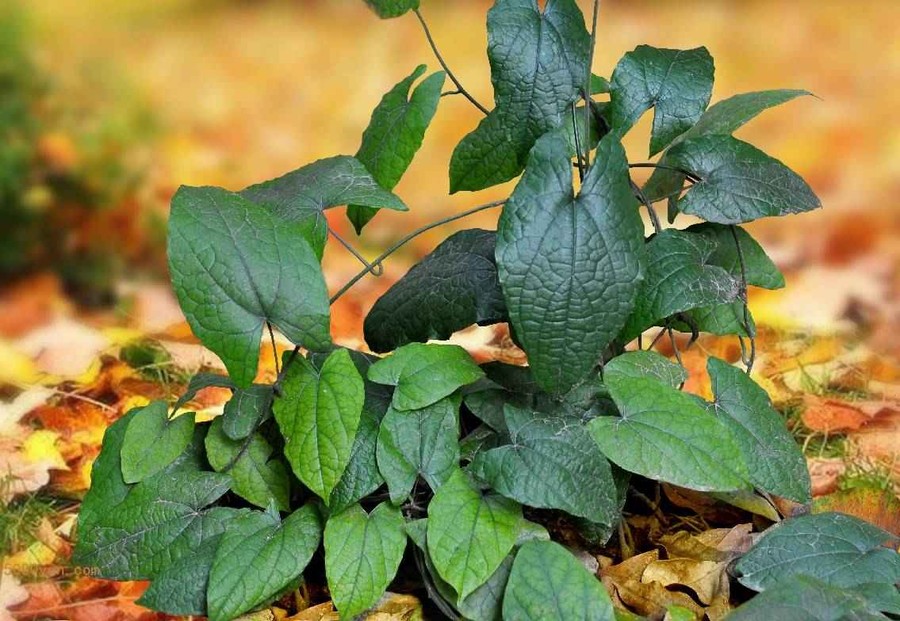
A perennial evergreen twining vine. The roots are slender, reaching about 1 m in length, with several clustered tuberous roots; the tuberous roots are ovoid, spherical, or lump-shaped, with a yellowish-brown outer bark and a light yellow interior, bitter in taste. The branches are slender, cylindrical, with longitudinal stripes. The leaves are papery to thin leathery, lanceolate, oblong-lanceolate, or ovate-lanceolate, 6-16 cm long, 2-8 cm wide, apex acuminate or acute, base sagittate or hastate, the sinus often deep, the posterior lobes rounded, obtuse, or shortly pointed, sometimes the two lobes overlapping each other, usually only the veins with short stiff hairs. Flowers unisexual, dioecious, yellowish-white, forming racemes or panicles, axillary, lax; male inflorescences often several clustered, female inflorescences often solitary; male flowers with 6 sepals in 2 whorls, 2.5-4 mm long; 6 petals, shorter than the sepals; 6 stamens, free. Drupes subglobose, white, turning red when ripe, maturing in autumn; endocarp subhemispherical, 6-9 mm wide.
Habitat and Distribution
Grows under sparse forests or in rock crevices beside mountain streams and valleys. Distributed in Shaanxi, Jiangxi, Hubei, Hunan, Guangdong, Guangxi, Sichuan, Guizhou, and other regions.
Harvesting and Processing
Harvested in autumn and winter, remove fibrous roots, wash clean, and sun-dry.
Medicinal Properties
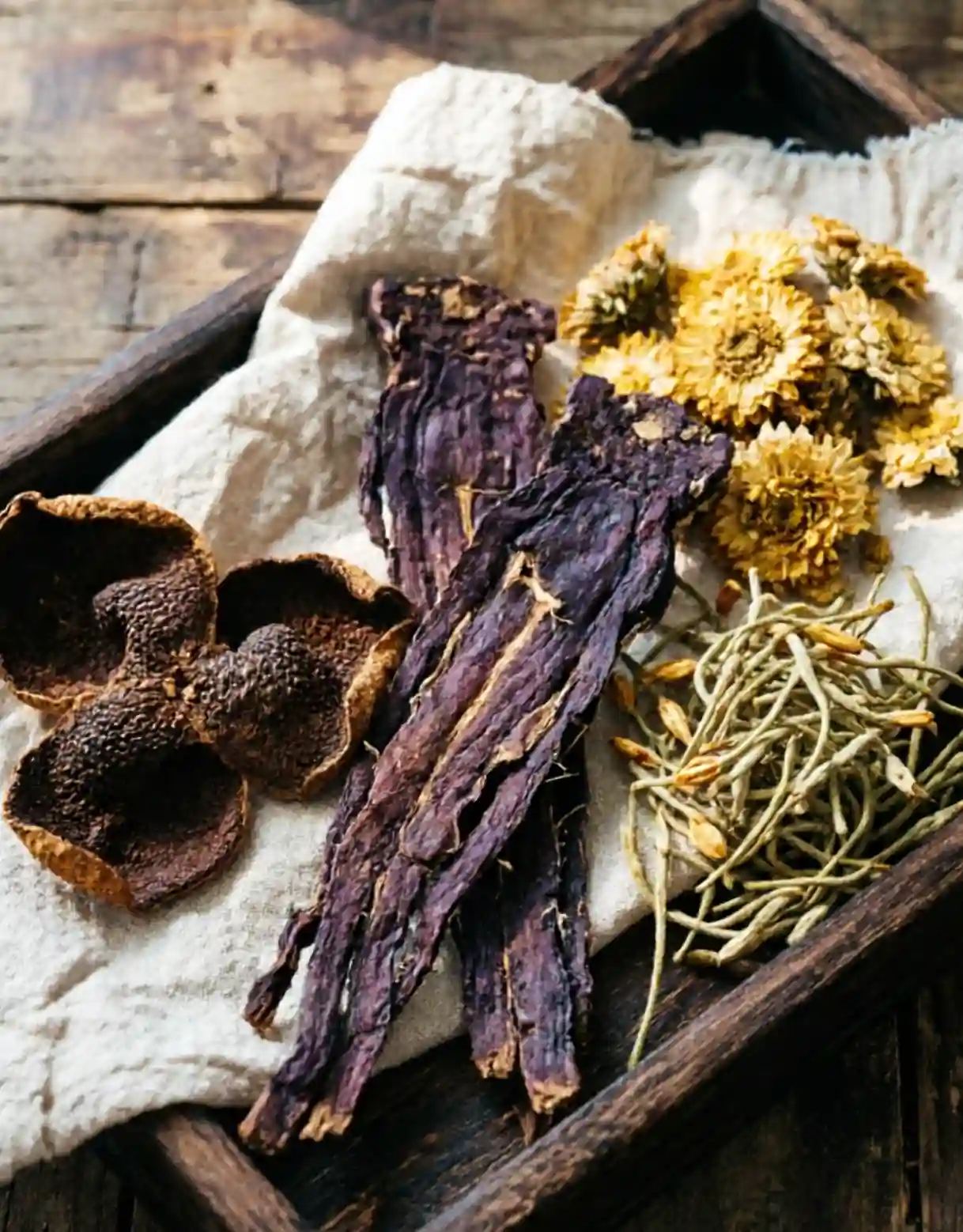
This irregularly rounded lump-shaped product is 5-10 cm long and 3-6 cm in diameter. The surface is brownish-yellow or light brown, rough and uneven, with deep wrinkles. The texture is hard and difficult to break or split open; the cross-section is pale yellowish-white, with vascular bundles arranged in a slightly radial pattern and darker in color. Odor: faint; Taste: bitter.
Chemical Constituents
This product contains columbin, palmatine, jatrorrhizine, 2-deoxy-ecdysterone, 2-deoxy-3-epi-ecdysterone, 2-deoxy-ecdysterone-3-O-β- pyranoglucoside, etc.
Pharmacology
Has antihypertensive and antitumor effects. Also has strong anticholinesterase activity. Toxic.
Properties and Channel Entry
Bitter, cold. Enters the Lung and Large Intestine channels.
Functions and Indications
Clears Heat and resolves toxicity, benefits the throat, and alleviates pain
Dosage and Administration
Internal: decoct in water, 3-9 g; grind into powder, 1-2 g per dose. External: apply an appropriate amount, mash for topical application or grind into powder for insufflation into the throat.
Precautions and Contraindications
For patients with Spleen and Stomach weakness or without Heat-toxin stagnation, use with caution.
Prescriptions
1. For acute dysentery: Jinguolan (Tinospora sagittata) finely ground into powder. Take 1 g each time, 3 times daily, for 5-7 consecutive days. (Jiangxi *Herbal Manual*) 2. For nephritis: Jinguolan 10 g, Jinqiancao (Lysimachia christinae) and Cheqiancao (Plantago asiatica) 30 g each. Decoct in water and take orally. (*Chinese Ethnic Medicine Records*) 3. For furuncles and carbuncles: Grind Jinguolan with water, add a small amount of Bingpian (borneol), mix well, and apply to the affected area. (*Chinese Ethnic Medicine Records*) 4. For scalds and burns: Jinguolan, Tudahuang (Rumex nepalensis), and Shengdiyu (Sanguisorba officinalis) in equal parts. Grind into fine powder, mix with sesame oil, and apply to the affected area. (*Anhui Chinese Herbal Medicine*) 5. For contact dermatitis: Fresh Jinguolan, decoct in water, and use the liquid for external washing. (*Selected Yunnan Chinese Herbal Medicine*)