Pinyin: Liangmianzhen
Aliases
Rudijinniu, Liangbianzhen, Shanjiao, Chushanhu
Source
Rutaceae plant *Zanthoxylum nitidum* (Roxb.) DC.Zanthoxylum nitidumDried root of (Roxb.) DC.
Botanical Description
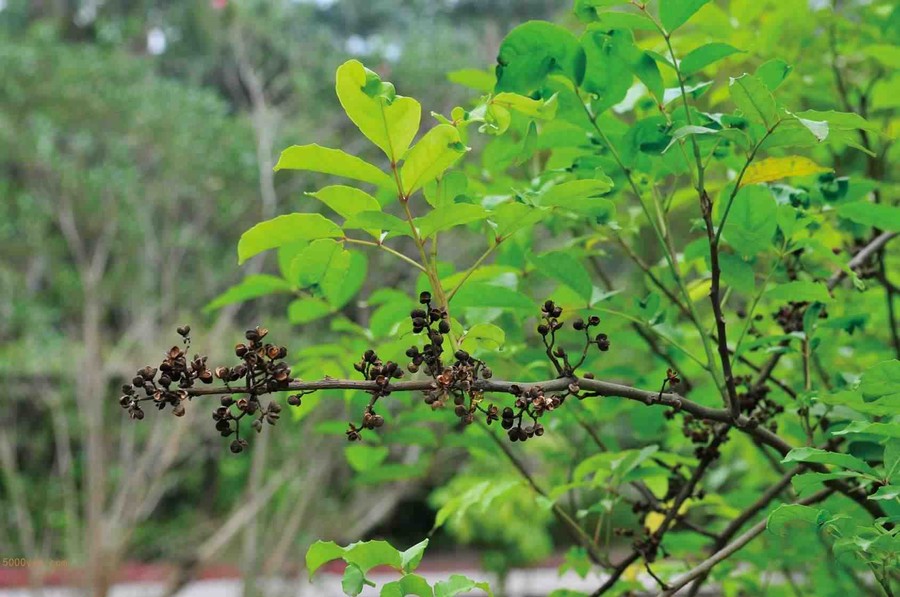
Evergreen woody vine, 1-2 m tall. Hook-like prickles present on young branches, abaxial surface of rachis, and both sides of midvein on leaflets. Odd-pinnate leaves alternate; petiole shorter than the lowermost leaflets on the rachis; petiolules 1-4 mm long; leaflets 3-11, ovate to ovate-oblong, 4-11 cm long, 2.5-6 cm wide, apex obtuse or shortly caudate, base rounded or broadly cuneate, margin nearly entire or with sparse rounded teeth, glabrous, leathery and glossy. Corymbose panicle, axillary, 2-8 cm long; pedicels 1-2 mm long; sepals 4, broadly ovate, less than 1 mm long; petals 4, ovate-oblong, about 2 mm long; stamens of male flowers 4, with a short mucro at the apex of the connective, degenerate carpels often 4-fid at apex; staminodes of female flowers very short and small, carpels 4. Mature carpels 1-4, purplish-red, surface wrinkled when dry. Follicle purplish-red when mature, with large glandular dots. Seeds ovoid, 5-6 mm in diameter, black and shiny. Flowering period March-April, fruiting period September-October.
Habitat and Distribution
Growing in low hillside shrublands, roadsides, and other sunny areas. Distributed in Zhejiang, Fujian, Taiwan, Hunan, Guangdong, Hainan, Guangxi, Sichuan, and Yunnan.
Harvesting and Processing
It can be harvested year-round, washed clean, sliced into pieces or segments, and dried in the sun.
Medicinal Properties
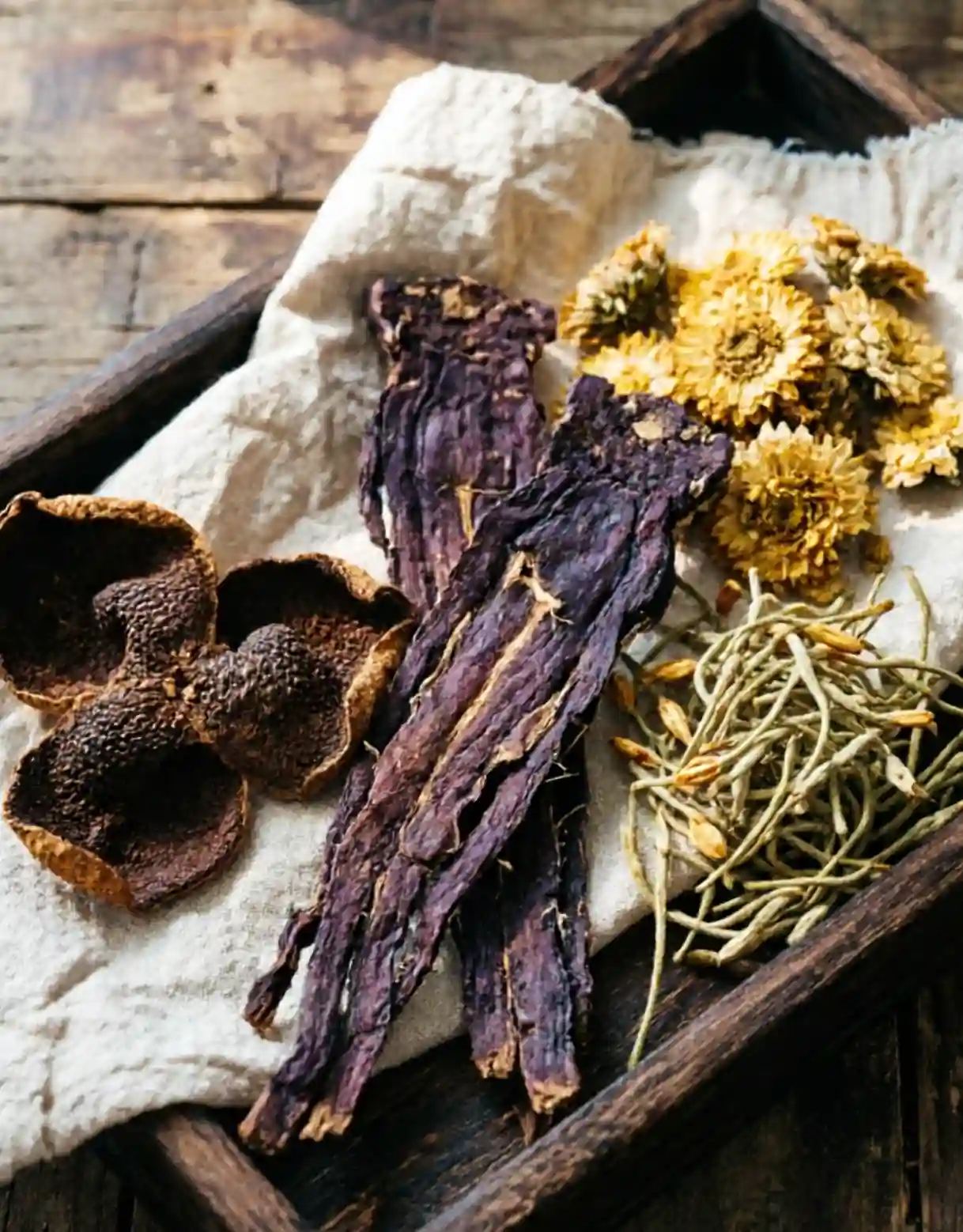
This product is in thick slices or cylindrical short segments, 2-20 cm long, 0.5-6 (10) cm thick. The surface is pale brownish-yellow or pale yellow, with bright yellow or yellowish-brown roundish lenticel-like spots. The cut surface is relatively smooth, with a pale brown bark region and a pale yellow wood region, showing concentric rings and dense small pores. The texture is hard. The odor is faintly aromatic, and the taste is pungent, numbing on the tongue, and bitter.
Chemical Constituents
This product mainly contains nitidine chloride, chelerythrine, isofagaridine, and lupeol, among other components.
Pharmacology
Has sedative, analgesic, and antispasmodic effects; induces catalepsy; cardiotonic, anticancer, antibacterial, local anesthetic, etc.
Properties and Channel Entry
Bitter, acrid, neutral; slightly toxic. Enters the Stomach and Liver channels.
Functions and Indications
Activates Blood and resolves stasis, moves Qi and alleviates pain, expels Wind and unblocks collaterals, and resolves toxicity and reduces swelling. Used for traumatic injuries, stomach pain, toothache, Wind-Damp Bi pain, and venomous snake bites; externally for burns and scalds.
Dosage and Administration
Oral: decoction, 4.5-9 g; powdered, 1.5-3 g; or steeped in wine. External: appropriate amount, decocted for washing or gargling; or fresh product mashed for topical application.
Precautions and Contraindications
Do not exceed the recommended dosage; avoid taking with sour foods. Contraindicated during pregnancy.
Prescriptions
1. For rheumatic joint pain: 15 g of Zanthoxylum nitidum root, 30 g of Urena lobata root. Decoct in water for oral administration. (Fujian Materia Medica) 2. For traumatic injuries: 30 g of fresh Zanthoxylum nitidum root, 15 g of fresh Ardisia crenata root, 1 pig trotter. Add appropriate amount of wine and water, stew and take. (Fujian Materia Medica) 3. For gastric and duodenal ulcers: 15 g of Zanthoxylum nitidum root, 30 g each of Fortunella venosa root and Pholidota chinensis. Decoct in water for oral administration. (Fujian Materia Medica) 4. For biliary ascariasis: 15 g each of Cudrania tricuspidata, Zanthoxylum nitidum, and Mahonia fortunei root. Decoct in water for oral administration. (Fujian Prescriptions of Chinese Herbal Medicine) 5. For intercostal neuralgia: 15 g each of Zanthoxylum nitidum root and Evolvulus alsinoides, 30 g each of Rhus chinensis root and Clausena lansium root. Decoct in water for oral administration. (Fujian Prescriptions of Chinese Herbal Medicine) 6. For dysentery: 15 g of Zanthoxylum nitidum root, 30 g of Polygonum chinense whole herb, 30 g of Psidium guajava leaf, 20 g of Eclipta prostrata. Decoct in water for oral administration, 1 dose daily. (Selected Prescriptions of Zhuang Folk Medicine) 7. For dental caries pain: Grind Zanthoxylum nitidum root bark into powder and apply to the painful area; or use 3-9 g of the root, decoct in water and use as a mouth rinse. (Guangxi Selected Herbal Medicine) 8. For venomous snake bite: 30 g of fresh Zanthoxylum nitidum root, decoct in water for oral administration; additionally, grind fresh root with wine and apply externally. (Fujian Chinese Herbal Medicine)