Pinyin: Baqia
Aliases
Jinganggen, Jingangci, Jingangtou, Lengfanba.
Source
The source material is a plant of the Liliaceae family, *Smilax china* L.Smilax chinaL. dried rhizome.
Botanical Description
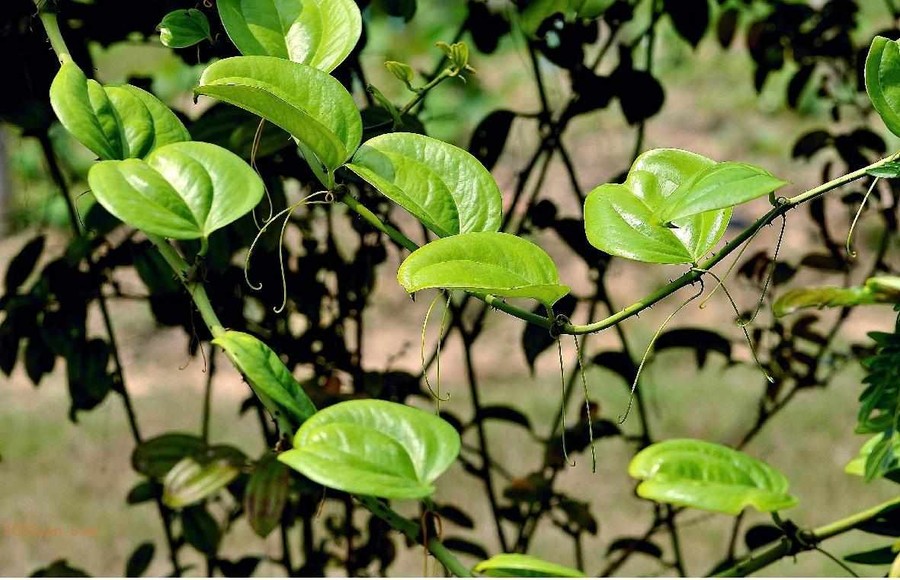
Climbing shrub, 1-3 m tall, sparsely thorny. Rhizome thick, hard, irregular tuberous root, 2-3 cm thick. Leaves alternate; petiole 5-15 mm long, with a narrow sheath 0.5-1 mm wide occupying 1/3 to 1/2 of its length, almost always with tendrils (rarely absent), abscission point near the tendril; leaf blade thin leathery or firm papery, ovate to orbicular, 3-10 cm long, 1.5-5 (-10) cm wide, base broadly cuneate to cordate, lower surface pale green, rarely glaucous, sometimes with bloom. Flowers unisexual, dioecious; umbels borne on young leafy branchlets, with ten or more flowers, often spherical; peduncle 1-2 cm long, receptacle slightly swollen, subglobose, rarely somewhat elongated, with bracteoles; flowers greenish-yellow, outer tepals 3, oblong, 3.5-4.5 mm long, 1.5-2 mm wide; inner tepals 3, slightly narrower. Stamens about 2/3 as long as tepals, anthers slightly wider than filaments, often curved; female flowers similar in size to male, with 6 staminodes. Berry 6-15 mm in diameter, red when ripe, with bloom. Flowering February to May, fruiting September to November.
Habitat and Distribution
It grows in understory shrublands, roadsides, river valleys, or hillsides at elevations below 2000 m. It is distributed in East China, Central South China, Southwest China, and Taiwan.
Harvesting and Processing
Harvest the rhizome in February or August, remove soil and fibrous roots, slice, and sun-dry.
Medicinal Properties
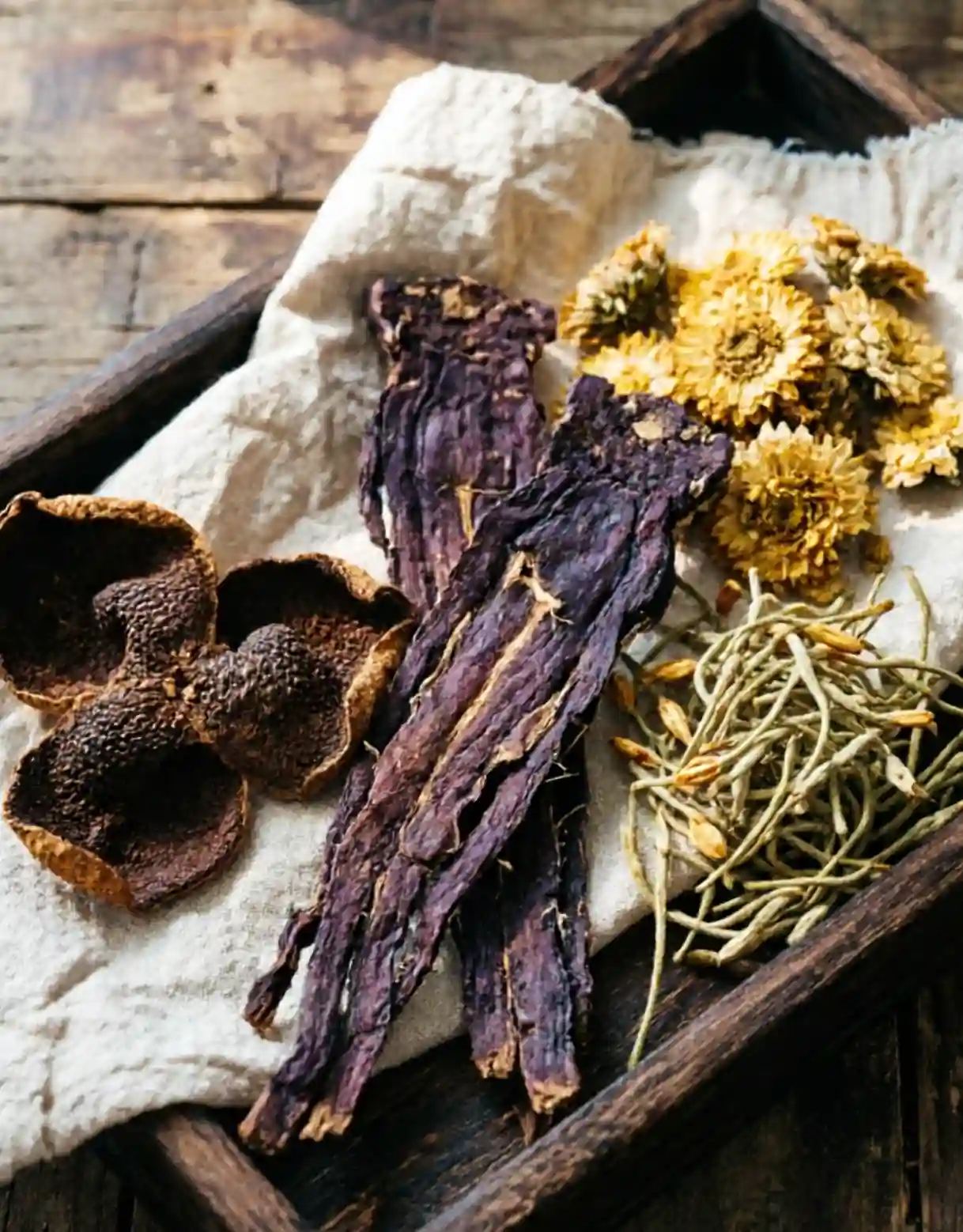
This product is cylindrical, slightly curved, or irregular in shape, 10-20 cm long and 2-4 cm in diameter. The surface is yellowish-brown or purplish-brown, with conical protruding stem scars, bud scars, and fine root fracture marks at the enlarged nodes, or with hard broken fine roots that are thorn-like, and scale leaves on the nodes; sometimes the remaining aerial stem is present at the apex. The texture is hard, the fracture surface is brownish-yellow or reddish-brown, and coarsely fibrous. Odor: faint; Taste: slightly bitter.
Chemical Constituents
This product contains astilbin, smilaxin, isobiflorin, kaempferol, kaempferol, dioscin, and isoquercitrin among other components.
Pharmacology
Has antibacterial, anti-inflammatory, and anti-tumor effects.
Properties and Channel Entry
Sweet, sour, and neutral; enters the Liver and Kidney channels.
Functions and Indications
Dispels Wind and eliminates Dampness, resolves toxicity and drains abscesses
Dosage and Administration
Oral administration: decoction, 10-30 g; or soak in wine; or made into pills or powder.
Precautions and Contraindications
Avoid vinegar and tea.
Prescriptions
1. For stranguria: Smilax china root (salt-fried) 15 g, Lonicera japonica 9 g, Polygonum aviculare 6 g. Decoction in water for oral administration. (Hunan Materia Medica) 2. For hematuria: Smilax china root and Glochidion puberum root, 30 g each. Decoction for oral administration. (Anhui Chinese Herbal Medicine) 3. For diabetes: Fresh Smilax china root 60-120 g, stewed with one pig pancreas. Take one dose daily. (New Compilation of Southern Zhejiang Herbal Medicine) 4. For metrorrhagia: Smilax china root and palm charcoal, 30 g each. Decoction for oral administration. (Anhui Chinese Herbal Medicine) 5. For hematemesis: Smilax china root 6 g and Ardisia japonica 9 g. Decoction in water for oral administration. (Hunan Materia Medica)