Pinyin: Baishao
Aliases
Baishao Yao, Jinshao Yao.
Source
Plant of the Ranunculaceae family, Paeonia lactiflora.Paeonia lactifloraDried root of Pall.
Botanical Description
Perennial herb, 40-70 cm tall, glabrous (hairless). Root enlarged, fusiform or cylindrical, dark brown. Stem erect, branched above, with several sheath-like membranous scales at base. Leaves alternate; petiole up to 9 cm long, shorter on upper stem leaves; lower stem leaves biternately compound, upper leaves ternately compound; leaflets narrowly ovate, elliptic, or lanceolate, 7.5-12 cm long, 2-4 cm wide, apex acuminate, base cuneate or oblique, margin with white bony serrulations, both surfaces glabrous, sparsely pubescent along veins beneath, subcoriaceous. Flowers bisexual, several at stem apex and leaf axils, 7-12 cm in diameter; bracts 4-5, lanceolate, unequal; sepals 4, broadly ovate to suborbicular, 1-1.5 cm long, 1-1.7 cm wide, green, persistent; petals 9-13, obovate, 3.5-6 cm long, 1.5-4.5 cm wide, white, sometimes with dark purple blotches or pink at base, cultivated forms variously colored and double-petaled; stamens numerous, filaments 7-12 mm long, anthers yellow; disc shallowly cup-shaped, enclosing base of carpels, apex lobes obtuse-rounded; carpels 2-5, free, glabrous. Follicle ovoid or ovoid-orbicular, 2.5-3 cm long, 1.2-1.5 cm in diameter, apex beaked. Flowering May-June, fruiting June-August.
Habitat and Distribution
It grows on hillside grasslands and under forests. It is distributed in Northeast China, North China, Shaanxi, and Gansu. It is widely cultivated in various cities and towns.
Harvesting and Processing
Harvested in summer and autumn, washed clean, remove the head, tail, and fine roots, place in boiling water and boil, then remove the outer skin or peel before boiling again, then dry in the sun.
Medicinal Properties
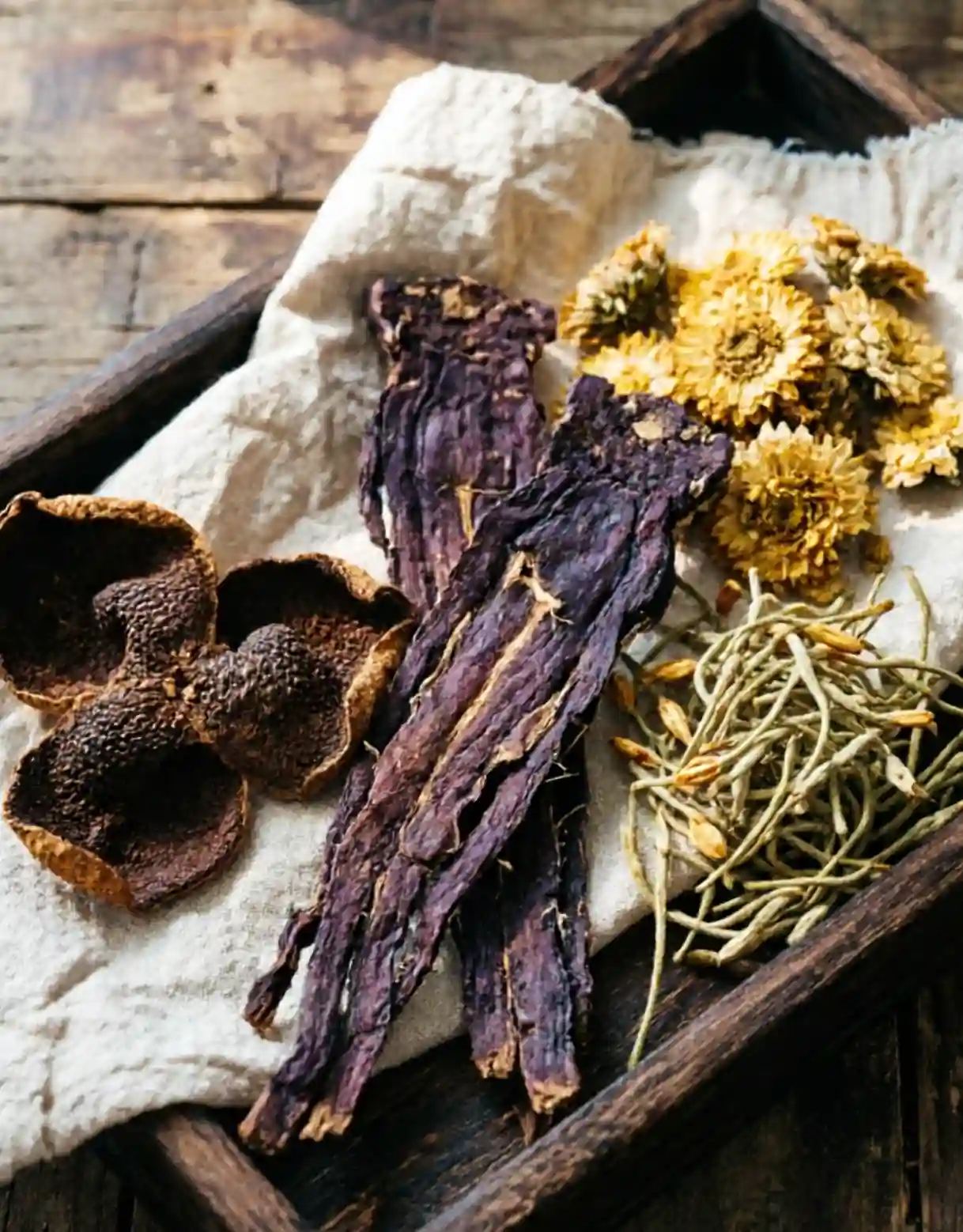
This product is cylindrical in shape, straight or slightly curved, with flat ends at both ends, 5-18 cm long and 1-2.5 cm in diameter. The surface is off-white or pale brownish-red, smooth or with longitudinal wrinkles and fine root marks, occasionally with remnants of brownish-black outer bark. The texture is firm and not easily broken; the cross-section is relatively flat, off-white or slightly brownish-red, with an obvious cambium ring and radiating rays. Odor: faint; Taste: slightly bitter and sour.
Chemical Constituents
This product contains paeoniflorin, oxypaeoniflorin, albiflorin, lactiflorin, hederagenin, paeoniflorigenone, galloylpaeoniflorin, and kaempferol-3,7-di-O-β-D-glucoside, daucosterol,β- Sitosterol, paeoniflorin lactoside, etc.
Pharmacology
It has a depressant effect on the central nervous system, can reduce fever and lower body temperature, and has sedative and hypnotic effects; it possesses antispasmodic, anti-inflammatory, anti-ulcer, and immunoenhancing effects on both cellular and humoral immunity; it dilates blood vessels, increases blood flow, enhances tolerance to hypoxia, lowers blood pressure, inhibits platelet aggregation, and has antibacterial, hepatoprotective, anti-mutagenic, anti-tumor, and mast cell histamine release inhibitory effects; it also causes depolarization at the neuromuscular junction; it is toxic.
Properties and Channel Entry
Bitter, sour, and slightly cold. Enters the Liver and Spleen channels.
Functions and Indications
Nourishes Blood and regulates menstruation, astringes Yin and stops sweating, softens the Liver and alleviates pain, and pacifies the Liver Yang. Used for Blood deficiency with sallow complexion, irregular menstruation, spontaneous sweating, night sweats, hypochondriac pain, abdominal pain, limb spasms and pain, headache, and dizziness.
Dosage and Administration
Oral: decoct in water, 5-12 g; or taken in pill or powder form. Large doses of 15-30 g may be used. For calming Liver Yang, use raw; for nourishing and softening the Liver, use stir-fried.
Precautions and Contraindications
For deficiency-cold patterns, it should not be used alone; it is incompatible with Lilu (Veratrum nigrum).
Prescriptions
1. For abdominal pain during pregnancy in women: Danggui 90 g, Baishao 480 g, Fuling 120 g, Baizhu 120 g, Zexie 240 g, Chuanxiong 240 g. Grind the above six ingredients into a powder. Take one fangcunbi (approximately 1-2 g) with wine, three times daily. (From "Jinkui Yaolüe" - Danggui Shaoyao San). 2. For postpartum heart and abdominal pain due to blood Qi attack: Baishao 60 g, Gui (remove rough bark) and Gancao (honey-fried, cut) 30 g each. Coarsely grind and sieve the above three ingredients. Take 9 g each time with one cup of water, decoct until seven-tenths remain, strain, and take warm, regardless of mealtime. (From "Puji Fang" - Shaoyao Tang). 3. For epistaxis (nosebleed) and hemoptysis (coughing blood): Baishao 30 g, Xijiao (rhinoceros horn) powder 0.3 g. Grind into powder, take with water, stop when bleeding ceases. (From "Gujin Luyan"). 4. For epistaxis and sweating blood: Baishao 75 g, fresh Shengdi juice two he, fresh Ou (lotus root) juice one he, fresh Shengjiang (ginger) juice a small amount. Grind Baishao into powder. First, boil the three juices until boiling. For each dose, take half a cup, add one he of boiled water and 6 g of Baishao powder, stir well, and take warm after meals. (From "Shengji Zonglu" - Baishao Yao San). 5. For diarrhea and abdominal pain: Huangqin and Baishao each 30 g, Gancao 15 g. Coarsely grind into powder. Take 15 g each time, decoct in water. (From "Baoming Ji" - Huangqin Shaoyao Tang).

