Pinyin: Zhimu
Aliases
Changzhi, Suanbianzicao, Dishen, Huaizhimu
Source
Liliaceae plant *Anemarrhena asphodeloides* Bge.Anemarrhena asphodeloidesDried rhizome of Bge.
Botanical Description
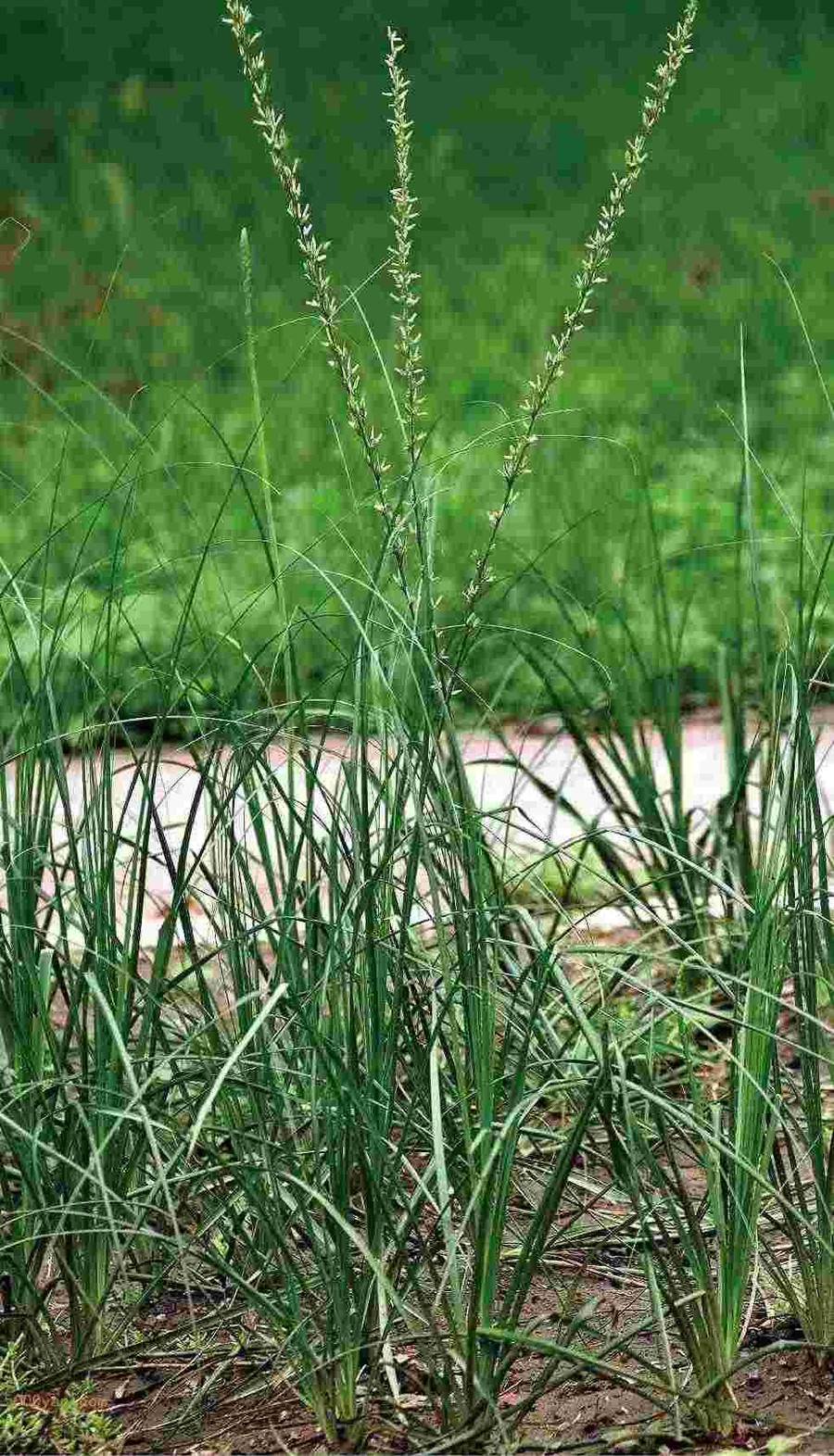
A perennial herb, entirely glabrous (hairless). Rhizome creeping, thick, densely covered with many yellowish-brown fibrous remnants of leaf bases, with numerous fleshy fibrous roots below. Leaves basal, tufted, linear, green above, dark green below, glabrous, slightly firm, leaf base expanded and enveloping the rhizome. Scape erect, unbranched, 50-120 cm tall, with lanceolate reduced leaves below and sparsely scaly bracteoles above; flowers 2-6 in a cluster, scattered on the upper part of the scape forming a long raceme; flowers yellowish-white, turning slightly purplish when dry, mostly opening at night, with short pedicels; perianth segments 6, slightly united at the base, arranged in 2 whorls, oblong, apex slightly incurved, margins thinner, with 3 pale green longitudinal veins; fertile stamens 3, inserted near the middle of the inner perianth whorl, anthers yellow; staminodes 3, inserted near the base of the outer perianth whorl, without anthers; pistil 1, ovary long-ovoid, 3-locular, style short, stigma 1. Capsule ovoid, when mature splitting along the ventral suture into 3 valves, each valve usually containing 1 seed. Seeds long-ovoid, 3-angled, one end pointed, black. Flowering period May to August, fruiting period July to September.
Habitat and Distribution
This is NOT a prescription or formula. It is a description of the habitat and distribution of a plant. Therefore, I will translate it accordingly, following the rules for content translation. Growing on sunny, dry slopes, hilly grasslands, or steppe areas, often in clusters. Distributed in Northeast and North China, as well as Shaanxi, Ningxia, Gansu, Shandong, and Jiangsu. It has been introduced and cultivated in Xinjiang, Anhui, Jiangxi, and Henan.
Harvesting and Processing
Harvested in spring and autumn, remove fibrous roots and sediment, sun-dry, commonly known as "Mao Zhimu"; or remove the outer skin and sun-dry.
Medicinal Properties
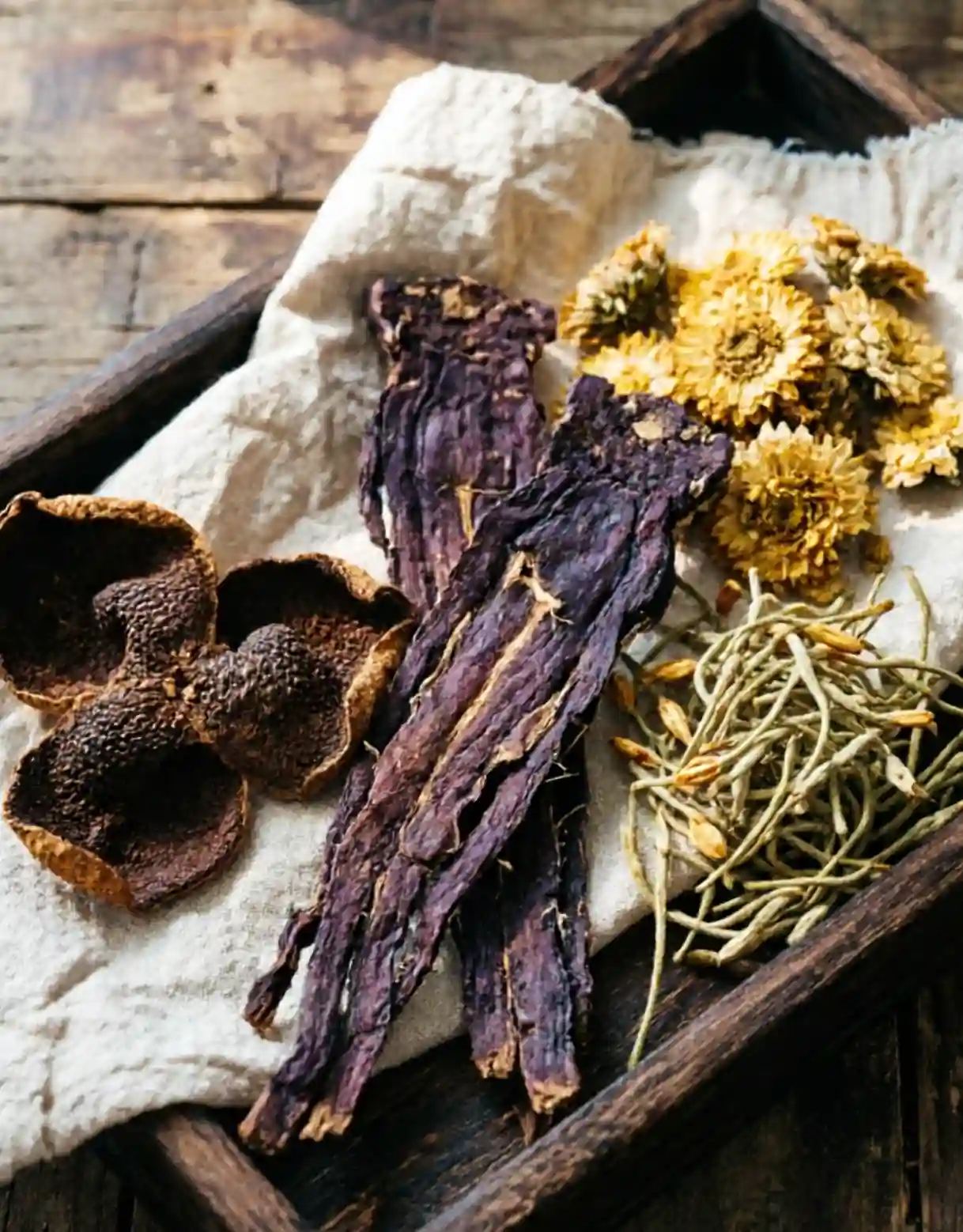
1. Maozhimu (Anemarrhena asphodeloides rhizome with hair-like remnants): The rhizome is flat-cylindrical and elongated, slightly curved, occasionally branched, 3-15 cm long, 0.8-1.5 cm in diameter. One end has a light yellow residual stem and leaf scar, commonly known as "Jinbaotou" (golden head). The surface is yellow-brown to brown, with a concave groove on the upper side, densely arranged annular nodes, and dense yellow-brown residual leaf bases on the nodes; the lower side is slightly convex, with longitudinal wrinkles, pitted root scars or fibrous root scars, and residual stems. The texture is hard and easily broken. The fracture surface is yellow-white and granular. Odor: faint; Taste: slightly sweet, slightly bitter, and sticky when chewed.
2. Zhimu flesh: Most of the outer skin has been removed, the surface is yellowish-white, with some residual few hair-like leaf stems and pit-like root scars.
Chemical Constituents
This product contains mangiferin, timosaponin A-Ⅰ, timosaponin A-Ⅱ, timosaponin A-Ⅲ, timosaponin A-Ⅳ, timosaponin B-Ⅰ, timosaponin B-Ⅱ, anemaran A, anemaran B, anemaran C, anemaran D, and hinokiresinol.β-β-sitosterol, timobiose, and others.
Pharmacology
Inhibits Na+-K+Inhibits the activity of ATPase; regulates the adrenergic and cholinergic nervous systems; delays the catabolism of cortisol by liver cells; lowers blood glucose; inhibits platelet aggregation; has antimicrobial effects; exhibits antipyretic activity; prolongs sleep time induced by hexobarbital; has choleretic and immunosuppressive effects.
Properties and Channel Entry
Bitter, sweet, and cold. Enters the Lung, Stomach, and Kidney channels.
Functions and Indications
Clears Heat, drains Fire, nourishes Yin, moistens Dryness, relieves thirst and eliminates restlessness. Indications: febrile diseases with high fever, thirst, vexation; cough and dyspnea; dry cough; constipation; steaming bone sensations and tidal fever; restlessness and insomnia; wasting-thirst disorder and turbid painful urinary dribbling.
Dosage and Administration
Internal: decoct 6-12 g, or made into pills or powder
Precautions and Contraindications
Contraindicated in cases of Spleen and Stomach deficiency-cold with loose stools or diarrhea.
Prescriptions
1. For typhoid fever with stomach heat, a feeling of restlessness and regret, a rapid and large pulse in all six positions, or bloody stools: Zhimu (Anemarrhena asphodeloides) 6 g, Huangqin (Scutellaria baicalensis) 6 g, Gancao (Glycyrrhiza uralensis) 3 g. Decoct in water and take while hot. (Zhimu Huangqin Tang, from *Bian Que's Heart Book*). 2. For pulmonary tuberculosis with heat, where Qi-tonifying formulas cannot be tolerated: Zhimu (Anemarrhena asphodeloides) (stir-fried) and Beimu (Fritillaria cirrhosa) (stir-fried), in equal parts. Grind into powder and take. (Er Mu San, from *Collection of Medical Prescriptions*). 3. For abdominal pain in a pregnant woman near term, as if about to give birth: Zhimu (Anemarrhena asphodeloides) 60 g, grind into powder, form into pills with honey the size of wutong seeds. Take 20 pills with rice porridge at any time. (Zhimu Wan, from *Sage's Benevolent Prescriptions*). 4. For nocturnal emission and spermatorrhea: Zhimu (Anemarrhena asphodeloides) 30 g, Huangbai (Phellodendron chinense) (peeled) 30 g, Huashi (Talcum) 90 g. Grind the above into powder, form into pills with plain water. Take on an empty stomach with warm wine or salted water. (Zhan Meng Dan, from *Universal Prescriptions for Relief*).