Pinyin: Sankezhen
Aliases
Tongzhenci
Source
Berberidaceae plant *Berberis soulieana*Berberis soulieanaThe dried roots of *Acanthopanax gracilistylus* W.W.Smith and several other plants of the same genus.
Botanical Description
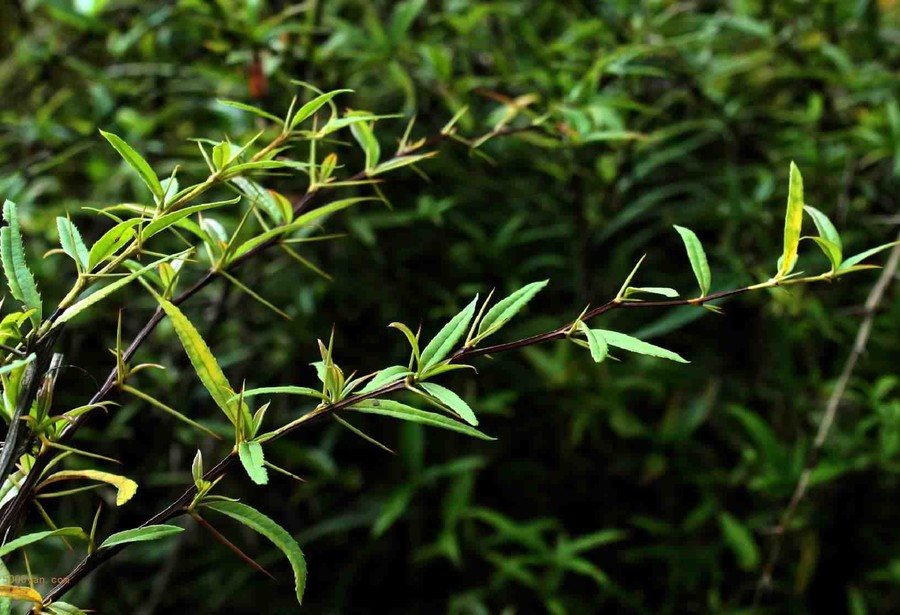
Evergreen shrub. Up to 2 m tall. Stems erect, much branched; young branches pale yellow, with a few warty points; spines hard, trifurcate, 1-2.5 cm long. Leaves clustered, leathery; leaf blade oblong-lanceolate, rarely oblong-obovate; apex acute, base abruptly narrowed into a very short petiole; upper surface green and glossy, lower surface yellow-green; margin with 5-18 spinose teeth, teeth 1.5-2.5 mm long, spaced 3-7 mm apart; lateral veins nearly perpendicular to midvein, veinlets inconspicuous. Flowers 8-20 in clusters; pedicels 5-15 mm long; bracteoles 2, ovate-oblong, about 2 mm long; sepals 6, in 2 whorls; petals 6, yellow, ovate to obovate; ovary ellipsoid, containing 2-3 (rarely 3) seeds; persistent style about 0.5 mm long. Berry ellipsoid, red when ripe, covered with white powder. Flowering March-April, fruiting August-October.
Habitat and Distribution
Born at altitudes of 600-2000 m on hillsides, roadsides, and forest edges. Distributed in Shaanxi, Gansu, Hubei, Sichuan, and other regions.
Harvesting and Processing
Harvested in spring and autumn, remove soil and fibrous roots, sun-dry or slice and sun-dry.
Medicinal Properties
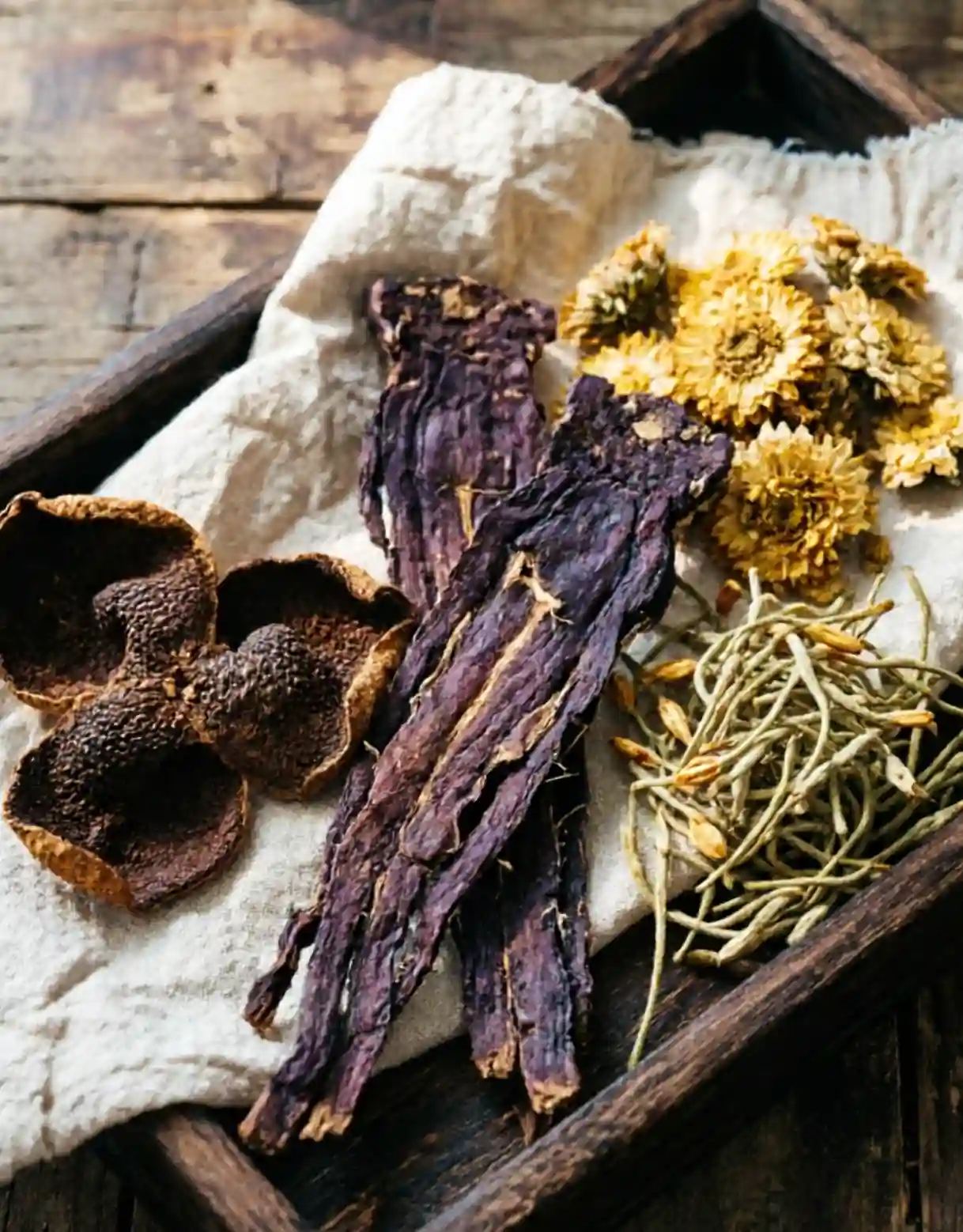
This product is in the shape of a cylindrical form, slightly twisted with a few branches, 10-15 cm long and 1-3 cm in diameter. The root head is thick and large, gradually tapering downward. The outer bark is grayish-brown with fine wrinkles and easily peels off. The texture is hard and not easily broken; the cut surface is uneven, fresh yellow in color, nearly round or oblong in cross-section, with slightly radial striations, and a brownish-yellow pith. The odor is faint, and the taste is bitter.
Chemical Constituents
This product primarily contains various alkaloids, mainly berberine, jatrorrhizine, palmatine, stepharine, coptisine, columbamine, magnoflorine, and phellodendrine, among others.
Pharmacology
Has anti-pathogenic microbial effects; raises white blood cell count; has blood pressure lowering and negative inotropic effects, dilates coronary blood vessels, and has anti-arrhythmic effects; has preventive and therapeutic effects on experimental silicosis; has anti-tumor effects.
Properties and Channel Entry
Bitter, cold; toxic. Enters the Liver, Stomach, and Large Intestine channels.
Functions and Indications
Clears Heat and dries Dampness, drains Fire and resolves toxicity
Dosage and Administration
Internal use: decoction, 15-30 g; or steep in wine. External use: appropriate amount, grind into powder for topical application.
Prescriptions
1. For jaundice: Sankezhen (Berberis) stem 15 g, decoct in water and take orally. (From "Guizhou Herbal Medicine") 2. For acute conjunctivitis with swelling and pain: Sankezhen 30 g, Cheqianzi (Plantago seed), Guangmingcao (Cassia seed), Juhua (Chrysanthemum) 9 g each, Longdancao (Gentian root) 12 g, decoct in water and take orally. (From "Sichuan Chinese Materia Medica" 1960) 3. For sore throat: Sankezhen 30 g, Shancigu (Cremastra pseudobulb), Xuedan (Hemsleya root) 9 g each, decoct in water and take orally. (From "Sichuan Chinese Materia Medica" 1960) 4. For eczema and furuncles: Sankezhen 2 parts, Huashi (Talcum) 4 parts, Qingdai (Indigo naturalis) 2 parts, Shengshigao (Gypsum) 4 parts, mix with petrolatum to make a 25% ointment, apply to the affected area. (From "Selected Chinese Herbal Medicines from Shaanxi, Gansu, Ningxia, and Qinghai")