Pinyin: Shuibanxia
Aliases
Shan Cigu, Tu Tianqi.
Source
Araceae plant *Typhonium flagelliforme*Typhonium flagelliformeDried tuber of (Lodd.) Bl.
Botanical Description
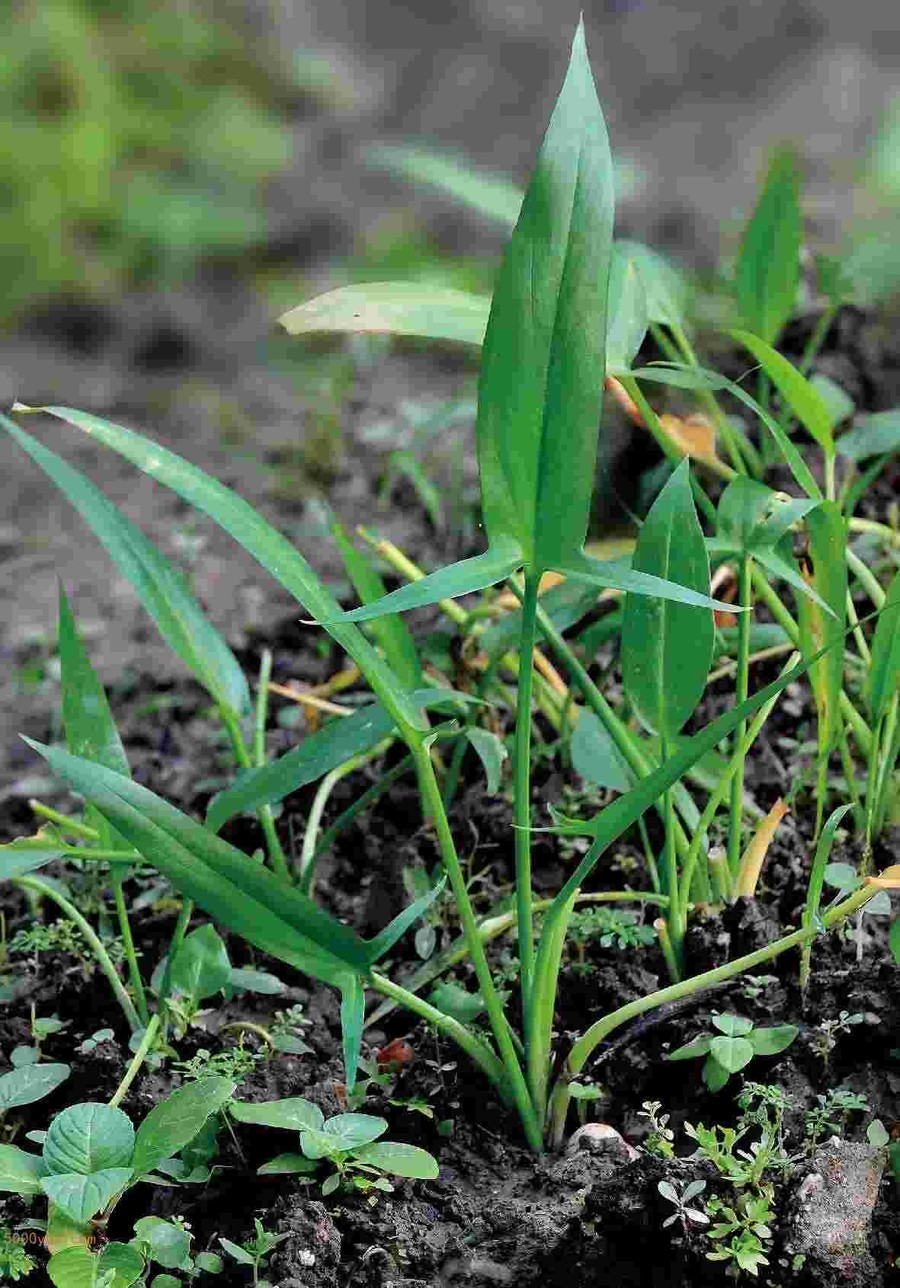
Perennial herb. Tuber nearly round, 1-2 cm in diameter, densely covered with fleshy roots around the upper part. Leaves 3-4; petiole with a broad sheath below the middle, base sheath up to 1.5-2 cm wide; leaf blade hastate-oblong, base cordate or decurrent, anterior lobe oblong or oblong-lanceolate, lateral lobes spreading horizontally or drooping outward, long-triangular; lateral veins 4-5 pairs, 1 pair basal, all ascending, inconspicuous on the back, collective veins 2, outer one near the margin, inner one 3-5 mm from the margin. Inflorescence stalk slender; spathe tube green, ovoid, limb green to green-white, lanceolate, often elongated and curled into a long whip-like form; spadix shorter or longer than the spathe; female inflorescence ovoid, 1.5-1.8 cm long, 8-10 mm thick at base; sterile inflorescence 1.7 cm long; male inflorescence 5-6 mm long, yellow; appendix pale yellow-green, stalked, lower part long-conical, upper part slender linear, total length 16-17 cm; female flowers with ovary obovoid or subglobose, stigma small; sterile flowers clavate below the middle, curved upward, yellow, apex purple; upper part conical, pale yellow, drooping and sometimes curved inward; male flowers with 2 stamens, anther chambers nearly globose. Berry ovoid. Flowering April to May, fruiting June to August.
Habitat and Distribution
It grows in shallow water of mountain streams, paddy fields, field edges, and other wetlands. It is distributed in Guangdong, Guangxi, Yunnan, and other regions.
Harvesting and Processing
Harvested in November, soaked in lime water for 24 hours, stirred with a wooden stick to remove the skin, then sun-dried or oven-dried, or used fresh.
Medicinal Properties
The tuber is slightly elliptic, conical, or semicircular in shape, 0.5-1.5 cm in diameter and 0.8-3 cm in height. The surface is off-white or pale yellow, uneven, with numerous faintly visible punctate root scars. The upper end is suborbicular, often with obliquely protruding, yellowish-brown leaf or bud scars. The lower end is sometimes slightly pointed. The texture is firm, the cut surface is white and powdery. The odor is faint, and the taste is acrid, numbing to the tongue and irritating to the throat. Those with a firm texture and abundant powder are considered superior.
Chemical Constituents
This product contains volatile oil, anthraquinones, carbohydrates, and other chemical constituents. The primary chemical components of the volatile oil include 4-hydroxy-4-methyl-2-pentanone, hexadecanoic acid, 8,11-octadecadienoic acid, and others.
Pharmacology
Expectorant, antitussive, antiemetic; inhibits salivary secretion; has central nervous system depressant effects; antioxidant, laxative, etc.
Properties and Channel Entry
Acrid, warm, toxic.
Functions and Indications
Dries Dampness and transforms Phlegm, resolves toxicity and reduces swelling, stops bleeding
Dosage and Administration
Oral: decoct in water, 3-9 g; or made into pills or powder. External use: mash for topical application; or grind into powder for topical application.
Precautions and Contraindications
For Yin deficiency dry cough and pregnant women, use with caution.