Pinyin: Yanhusuo
Aliases
Xuanhusuo, Yuanhusuo, Yuanhu.
Source
Family: Papaveraceae; Plant: *Corydalis yanhusuo*Corydalis yanhusuoW.T.Wang's dried tuber.
Botanical Description
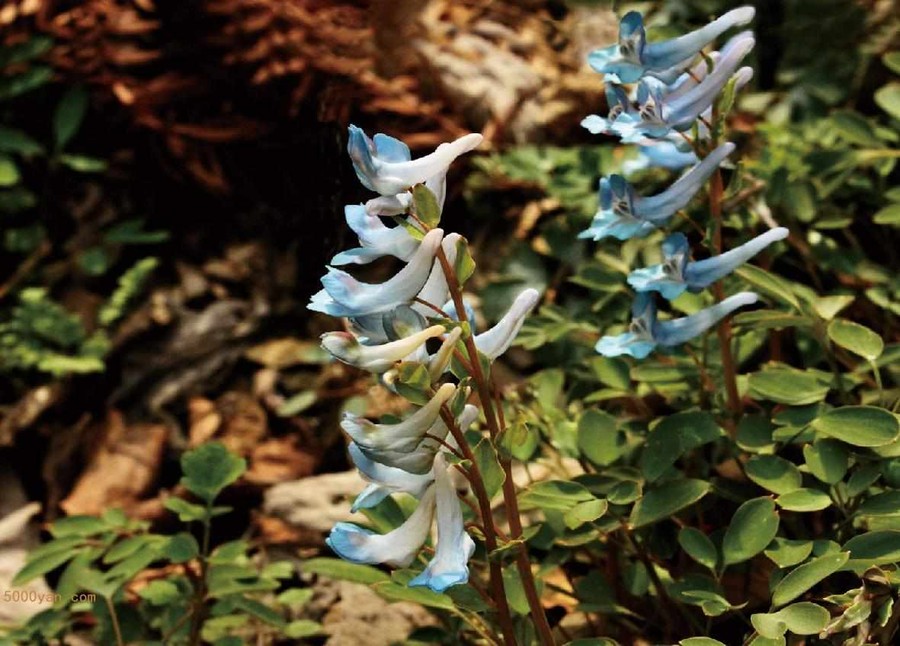
Perennial herb, 9-20 cm tall, entirely glabrous (hairless). Tuber depressed-globose, 7-15 mm in diameter, slightly concave at the upper part, with fibrous roots at the lower part, sometimes longitudinally split into several lobes, deep yellow in cross-section. Stem erect or oblique, usually single, with 1 scale near the base, often swollen at nodes into small tubers, which produce new stems, and new stem nodes again form small tubers, often in chains of 3-4. Basal leaves 2-4, petiole 3-8 cm long; leaf blade broadly triangular in outline, 3-6 cm long, 4-8 cm wide, bi-triternate, primary segments petiolulate, ultimate segments subsessile, lanceolate to oblong, 20-30 mm long, 5-8 mm wide, entire, a few with upper half bi-lobed to shallowly lobed; cauline leaves usually 2, alternate, smaller than basal leaves but similar in shape. Raceme terminal, 2-5 cm long, sparsely with 3-8 flowers; bracts ovate to narrowly ovate, those at lower part of inflorescence about 10 mm long, apex 3-5-lobed, those at upper part entire; sepals 2, minute, caducous; corolla pale purple-red, petals 4, in 2 whorls, outer upper petal largest, 15-25 mm long, upper part spreading into broadly obovate to broadly elliptic hood-shaped lobes, margin with small teeth, apex slightly emarginate, middle-lower part extended into a long spur, lower petal shorter, similar in shape to upper petal, base with a shallow saccate protrusion, inner two petals 10-15 mm long, clasping around the stamens, upper part broadly obovate, middle and lower parts slender into claws; stamens 6, slightly shorter than inner petals, each 3 united into a fascicle; ovary linear, 8-10 mm long, style slender and short, stigma suborbicular, with 8 papillae. Capsule linear, 1.7-2.2 cm long, style and stigma persistent, splitting into 2 valves when mature. Seeds in 1 row, several, minute, flat-oblong, black, glossy, surface densely with small pits. Cultivated plants often only flower, fruit falls before maturity. Flowering period March-April, fruiting period April-May.
Habitat and Distribution
It grows in open grasslands and hilly forest edges at low altitudes. It is distributed in Shaanxi, Jiangsu, Anhui, Zhejiang, Henan, Hubei, and other regions. It is extensively cultivated in Dongyang, Pan'an, Yongkang in Zhejiang, and the Nantong area in Jiangsu.
Harvesting and Processing
Harvest in early summer when the stems and leaves wither, dig up the roots, remove the fibrous roots, wash clean, blanch in boiling water until no white core remains when cut, remove, and sun-dry.
Medicinal Properties
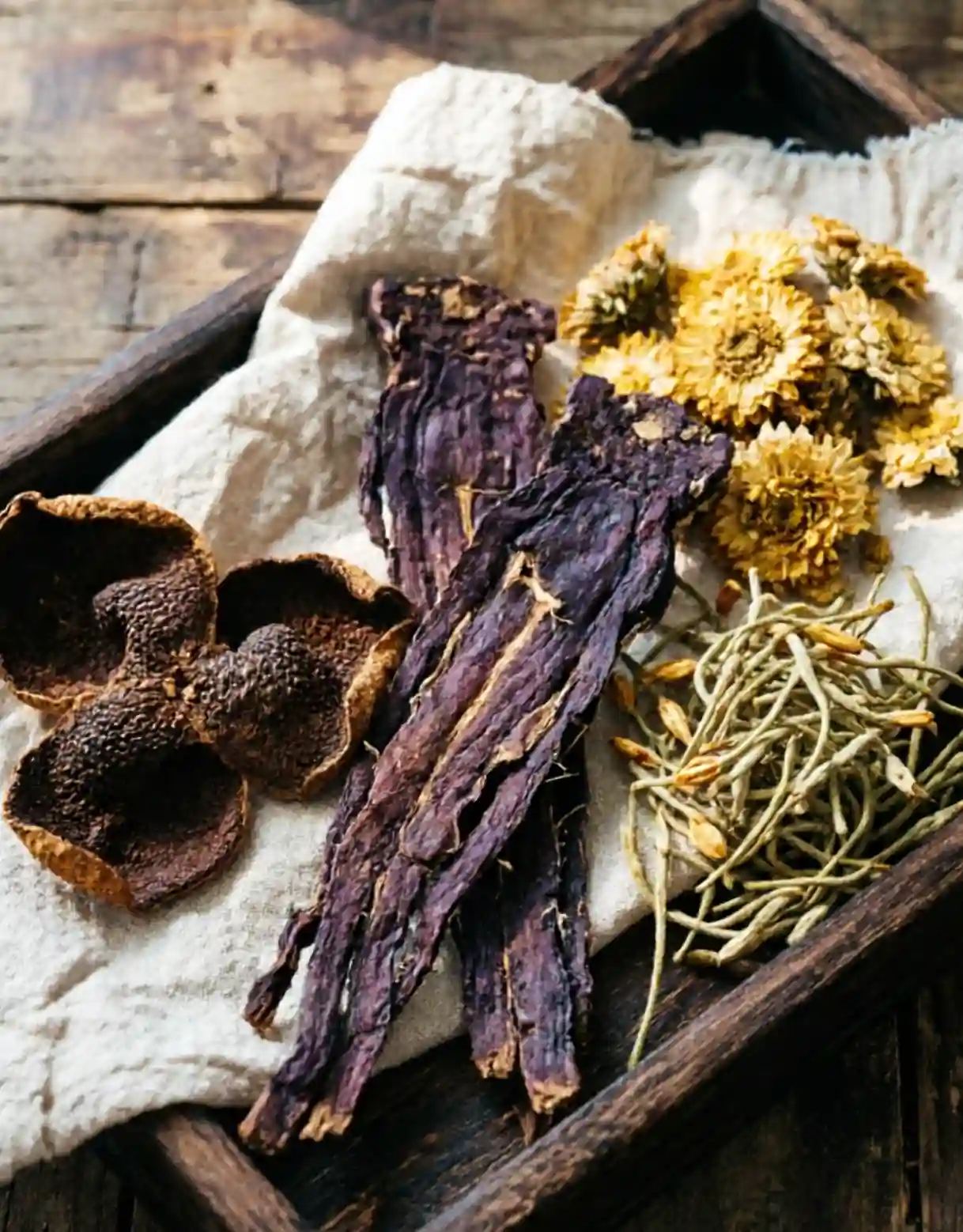
The tuber is flat-spherical, 5-18 mm in diameter. The surface is grayish-yellow or yellowish-brown, with irregular fine reticulate wrinkles; the slightly concave base shows stem scars or root scars, surrounded by several small protrusions; the upper part or sides have several varying-sized knot-like lateral tubers, with stem scars and buds in the central depression of the upper part of the main and lateral tubers, some tubers appearing "split" or divided into 2-3 lobes at the top. The texture is hard, difficult to break, with a yellow or yellowish-brown, horny fracture and a waxy luster. Odor: faint; Taste: bitter.
Chemical Constituents
This product contains tetrahydropalmatine, chloroform-palmatine, isocorydine, berberine, cryptopine, dehydrochelerythrine, dihydrosanguinarine, corydaline, tetrahydroberberine, linoleic acid, vanillic acid, daucosterol, dehydrocorydalmine, and other compounds.
Pharmacology
Analgesic, hypnotic, sedative, and tranquilizing; anticonvulsant; dilates coronary arteries; suppresses cardiac function; antiarrhythmic; antiulcer; promotes pituitary secretion of adrenocorticotropic hormone. Toxic.
Properties and Channel Entry
Acrid, bitter, and warm. Enters the Liver and Spleen channels.
Functions and Indications
Activates Blood, moves Qi, and alleviates pain
Dosage and Administration
Oral: decoct in water, 3-10 g; grind into powder, 1.5-3 g; or prepared into pills or powders.
Precautions and Contraindications
Pregnant women should avoid taking this; those with weak constitution should use with caution.
Prescriptions
1. For cold pain in the heart and abdomen, intestinal gurgling with moving gas, chills with spontaneous sweating, and watery diarrhea: Yanhusuo (Corydalis Rhizoma) and Fuzi (Aconiti Lateralis Radix Praeparata) each 30 g, Muxiang (Aucklandiae Radix) 15 g. Take 12 g per dose, decoct with seven slices of Shengjiang (Zingiberis Rhizoma Recens) and take orally. (Yan Fu Tang, from *Yanshi Jisheng Fang*). 2. For heart and abdominal pain due to blood stasis: Yanhusuo (Corydalis Rhizoma, stir-fried with vinegar), Wulingzhi (Trogopterori Faeces, stir-fried with vinegar), Caoguo (Tsaoko Fructus), and Moyao (Myrrha) in equal parts. Grind into a fine powder, take 9 g per dose, adjusted with hot wine. (Shou Nian San, from *Yizong Bidu*). 3. For hernia pain: Yanhusuo (Corydalis Rhizoma) and Hujiao (Piperis Nigri Fructus) powder in equal parts. Take 6 g per dose, decoct with half a cup each of wine and water, reduce to seven-tenths, and take orally. (*Weisheng Yijian Fang*). 4. For painful menstrual cramps with abdominal masses: Yanhusuo (Corydalis Rhizoma) 8 g, Xueyutan (Crinis Carbonisatus) 4 g, ground into powder. Divide into two doses (morning and afternoon), adjust with yellow wine and take. Take continuously for 7 days. (From *Shandong Journal of Traditional Chinese Medicine*, 1984, (3): 50). 5. For postpartum pain in the lower abdomen and below the navel: Yanhusuo (Corydalis Rhizoma) and Guixin (Cinnamomi Cortex) each 15 g, Danggui (Angelicae Sinensis Radix) 30 g. Grind into a fine powder, adjust with hot wine and take. (Yan Hu San, from *Puji Fang*).