Pinyin: Qianhu
Source
Plant of the Apiaceae family: Peucedanum praeruptorumPeucedanum pra-eruptorumDried root of Dunn.
Botanical Description
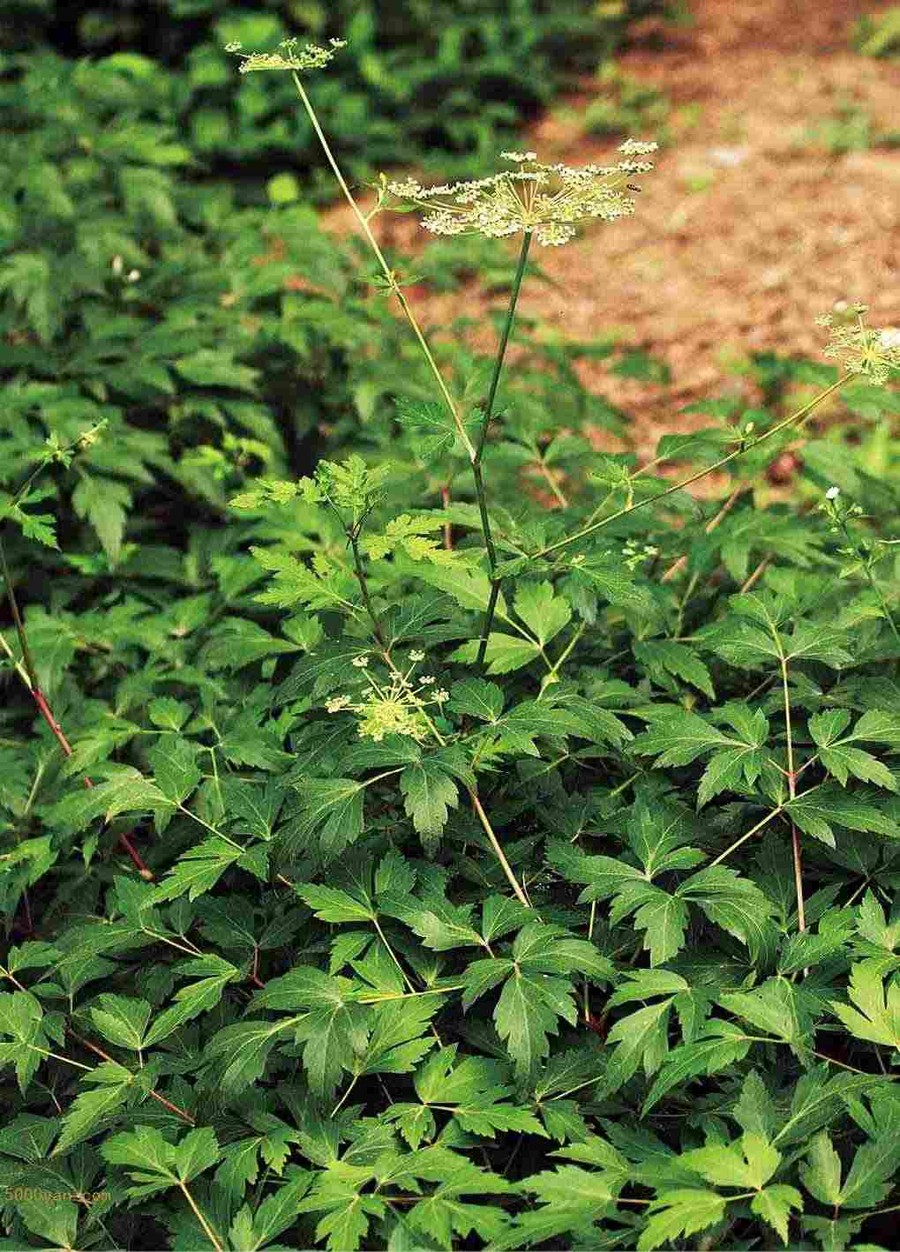
Perennial herb, 60-100 cm tall. Root conical, with a few lateral roots, surface yellowish-brown to brownish-black, apex of root head with numerous persistent brownish-brown leaf sheath fibers. Stem erect, terete, branched in the upper part, pubescent, glabrous in the lower part. Basal leaves long-petiolate, base expanded into sheaths, clasping; leaf blades broadly triangular-ovate, ternate or 2-3 times pinnately divided, with 2-3 pairs of primary pinnae, the lowest pair long-petiolate, the others short-petiolate or sessile; ultimate segments rhomboid-obovate, apex acuminate, base cuneate to truncate, margin irregularly 3-4 coarsely or rounded serrate, sometimes lower teeth shallowly or deeply lobed, veins prominently raised on lower surface, both surfaces glabrous or occasionally sparsely short-hairy on lower veins and margins; stem leaves similar to basal leaves but smaller; upper stem leaves sessile, ternate, segments narrow, base cuneate, the middle one decurrent. Compound umbel terminal or lateral, rays 6-18, unequal, pubescent; involucral bracts 1 to several, caducous after anthesis, linear-lanceolate, margin membranous, pubescent; umbellules with 15-20 flowers, pedicels unequal, pubescent; involucel bractlets 7-12, ovate-lanceolate, apex long-acuminate, equal to or exceeding pedicels, pubescent; calyx teeth inconspicuous; petals 5, white, broadly ovate to suborbicular; stamens 5; style short, curved, stylopodium conical. Fruit ovoid, dorsally compressed, brown, sparsely short-hairy, dorsal ribs linear, slightly prominent, lateral ribs winged, narrower and slightly thicker than the fruit body, vittae 3-5 in each furrow, 6-10 on the commissure, endosperm flat on the ventral side. Flowering July to September, fruiting October to November.
Habitat and Distribution
It grows at altitudes of 250-2000 m on forest margins of mountain slopes, roadsides, or semi-shaded grassy slopes. It is distributed in Gansu, Jiangsu, Anhui, Zhejiang, Jiangxi (Wuyi Mountain), Henan, Hubei, Hunan, Guangxi, Sichuan, Guizhou, and other regions.
Harvesting and Processing
Harvested in winter until the following spring when the stems and leaves wither or before the flower stems emerge, remove the fibrous roots, wash thoroughly, and sun-dry or dry at low temperature.
Medicinal Properties
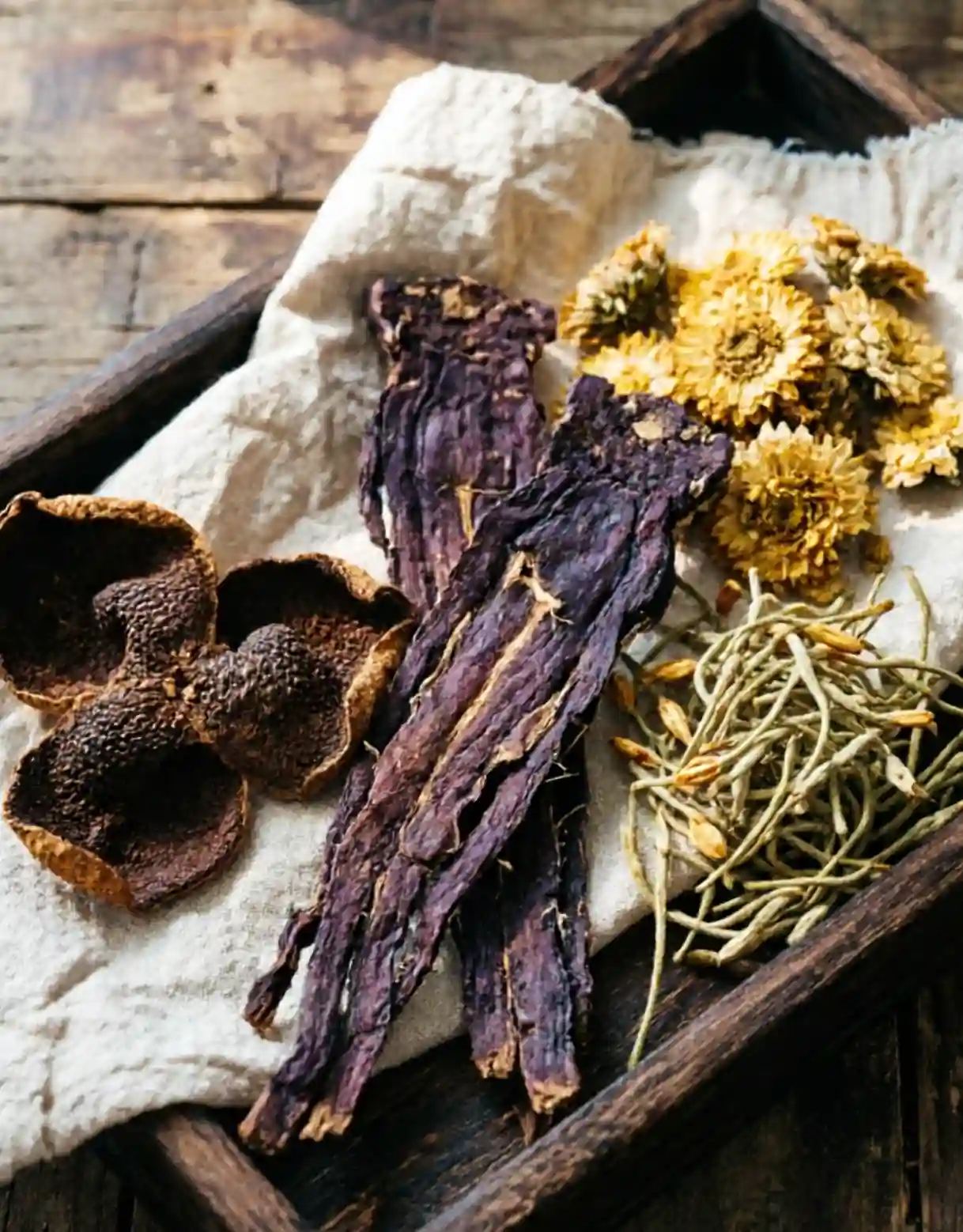
This product is irregularly cylindrical, conical, or fusiform in shape, slightly twisted, with frequent branching in the lower part, 3-15 cm long and 1-2 cm in diameter. The surface is dark brown or grayish-yellow, with multiple stem scars and fibrous leaf sheath remnants at the root head, dense fine annular striae at the upper end, and longitudinal grooves, longitudinal wrinkles, and transverse lenticel-like protrusions in the lower part. The texture is relatively soft; dry specimens are hard and breakable, with an uneven fracture surface that is pale yellowish-white, scattered with numerous brownish-yellow oil spots in the bark region, a brown cambium ring, and radial rays. The odor is aromatic; the taste is slightly bitter and acrid.
Chemical Constituents
This product contains praeruptorin A, praeruptorin B, nodakenin, nodakensaponin V, praeruptorin I, praeruptorin II, praeruptorin III, and other constituents.
Properties and Channel Entry
Bitter, acrid, slightly cold. Enters the Lung channel.
Functions and Indications
Descends Qi and transforms Phlegm, disperses Wind and clears Heat. Used for Phlegm-Heat with wheezing and fullness, cough with yellow, thick sputum, and Wind-Heat cough with copious sputum.
Dosage and Administration
Internal use: decoction, 5-10 g; or in pill or powder form.
Precautions and Contraindications
Patients with Yin-deficiency cough or cold-fluid cough should use with caution.
Prescriptions
1. For cough with thick, sticky sputum, chest discomfort, and occasional irritability and fever: Qianhu (Radix Peucedani) 30 g (without head), Maimendong (Radix Ophiopogonis) 45 g (without core), Beimu (Bulbus Fritillariae Cirrhosae, roasted slightly yellow) 30 g, Sanggenbaipi (Cortex Mori, cut) 30 g, Xingren (Semen Armeniacae Amarum, soaked in water, peeled and tipped, stir-fried with bran until slightly yellow) 15 g, Gancao (Radix et Rhizoma Glycyrrhizae, roasted slightly red, cut) 0.3 g. Grind the above ingredients into a powder. Take 12 g per dose, add 0.5 cups of water and 0.15 g of fresh ginger, decoct until 60% of the liquid remains, strain, and take warm at any time. (From "Shenghui Fang": Qianhu San) 2. For lung wheezing with toxic stagnation in the heart and diaphragm causing chest oppression: Qianhu (Radix Peucedani, without head), Ziwan (Radix Asteris, washed and rootlets removed), Heliupi (Pericarpium Granati), Zhishi (Fructus Aurantii Immaturus, stir-fried with bran until slightly yellow) each 30 g. Grind into a powder. Take 3 g per dose, mix with warm water, and take at any time. (From "Puji Fang": Qianhu Tang) 3. For febrile diseases during pregnancy with headache and high fever: Qianhu (Radix Peucedani, without head), Huangqin (Radix Scutellariae, without black core), Shigao (Gypsum Fibrosum, crushed), Ejiao (Colla Corii Asini, roasted and baked) each 30 g. Coarsely grind and sift. Take 9 g per dose, add 1 cup of water, decoct until 70% of the liquid remains, strain, and take warm at any time. (From "Puji Fang": Qianhu Tang) 4. For bone-steaming fever: Qianhu 3 g, Chaihu (Radix Bupleuri) 6 g, Huhuanglian (Rhizoma Picrorhizae) 3 g, one pig spinal cord, one pig gallbladder. Decoct in water, add the pig bile before taking. (From "Guoyi Zongzhi") 5. For infantile wind-heat crying: Qianhu (Radix Peucedani, without head). Grind into powder, mix with honey and form into pills the size of small beans. Take one pill daily, swallow with boiled water. After taking 5-6 pills, the condition should resolve. (From "Xiao'er Weisheng Zongwei Lun Fang": Qianhu Wan)