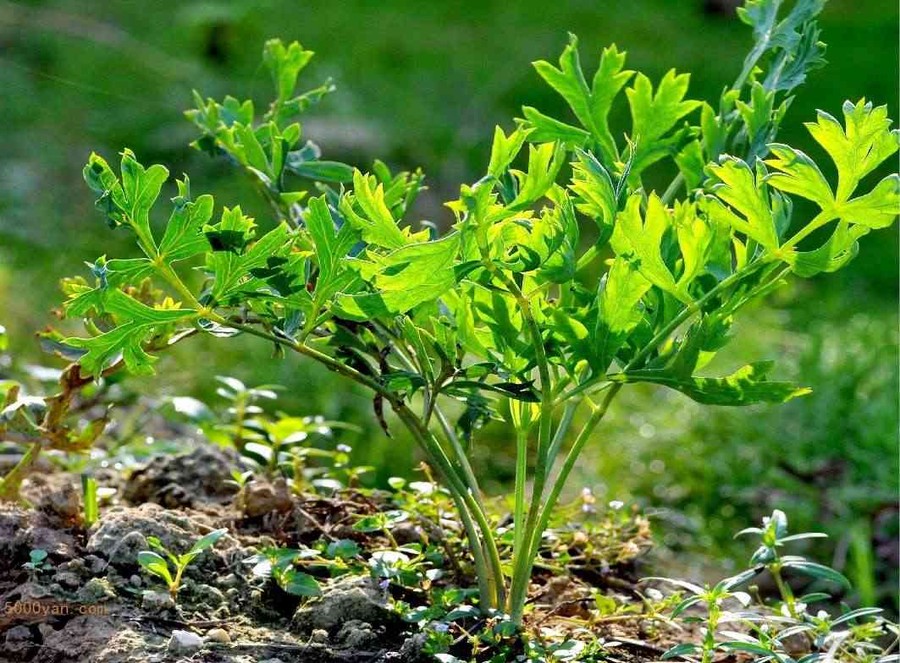
Pinyin: Fangfeng
Aliases
Tongyun, Baijiu, Pingfeng.
Source
Apiaceae plant FangfengSaposhnikovia divaricata(Turcz.) Schischk. is the dried root.
Botanical Description
Perennial herb, 30-80 cm tall. Root robust, long cylindrical, branched, pale yellowish-brown, with dense fibrous petiole remnants and distinct ring scars at the crown. Stem solitary, dichotomously branched, branches ascending, nearly as long as the main stem, with fine ridges. Basal leaves clustered, with flat long petioles, base with broad leaf sheaths, slightly clasping the stem; leaf blade ovate or oblong, 14-35 cm long, 6-8 (-18) cm wide, 2-3 times pinnately divided; primary divisions ovate or oblong, petiolulate, 5-8 cm long; secondary divisions with short petiolules below; ultimate segments narrowly cuneate, 2.5-5 cm long, 1-2.5 cm wide; upper leaves reduced, with broad leaf sheaths. Compound umbels numerous, terminal on stem and branches; terminal peduncle 2-5 cm long; rays 5-7, 3-5 cm long, glabrous; involucre absent; umbellules with 4-10 flowers; involucel bracteoles 4-6, linear or lanceolate, ca. 3 mm long; calyx teeth triangular-ovate; petals obovate, white, ca. 1.5 cm long, glabrous, apex emarginate with inflexed tip. Mericarps narrowly oblong or elliptic, 4-5 mm long, 2-3 mm wide, tuberculate when young, becoming smooth at maturity; each vittae 1 per furrow, 2 on commissure. Flowering August-September, fruiting September-October.
Habitat and Distribution
Born in grasslands, hills, and gravelly slopes. Distributed in Northeast China, North China, and Shaanxi, Gansu, Ningxia, Shandong and other regions.
Harvesting and Processing
In spring and autumn, dig up the roots of plants that have not yet produced flower stems, remove the fibrous roots and soil, and dry them in the sun.
Medicinal Properties
The root is long conical or long cylindrical, tapering towards the lower part, sometimes slightly curved, 15-30 cm long, 0.5-2 cm in diameter. The outer surface is grayish-brown, rough, with longitudinal wrinkles, numerous transversely elongated lenticel protrusions, and punctate fine root scars. The crown has distinct and dense annular rings, some of which bear residual brownish hairy leaf bases. Light in weight, loose texture, easily broken; the fracture is uneven, with a light brown bark showing fissures and scattered yellowish-brown oil spots, and a light yellow wood. Odor: distinctive; Taste: slightly sweet.
Chemical Constituents
This product contains cimicifugin glycoside,γ- Bibaoshanene, fengselins, hama phenol, cimifugin, methyleugenol.β-α-pinene, cimifugin glycoside, peucedanin, Saposhnikovia acidic polysaccharide, falcarindiol, and vanillic acid.
Pharmacology
Antipyretic and fever-reducing; analgesic, sedative, and anticonvulsant; antibacterial; anti-inflammatory; enhances immune system function; inhibits contraction of isolated duodenum, isolated trachea, and ileal smooth muscle; antihistamine; anticoagulant.
Properties and Channel Entry
Acrid, sweet, and slightly warm. Enters the Urinary Bladder, Spleen, and Liver channels.
Functions and Indications
Expels Wind and releases the Exterior, overcomes Dampness and alleviates pain, and stops spasms. Mainly indicated for colds with headache, Wind-Damp Bi pain (rheumatic arthralgia), and tetanus.
Dosage and Administration
Internal: decoct in water, 5-10 g; or made into pills or powder
Precautions and Contraindications
Those with blood deficiency causing convulsions and those with yin deficiency and exuberant fire should use with caution.
Prescriptions
1. For spontaneous sweating: Fangfeng (Ledebouriella root) and Huangqi (Astragalus root) each 30 g, Baizhu (Atractylodes rhizome) 60 g. Take 9 g per dose, with 1.5 cups of water and 3 slices of ginger, decoct and take. (Yupingfeng Powder from Danxi Xinfa) 2. For intractable migraine or headache: Fangfeng (Ledebouriella root) and Baizhi (Angelica root) each 120 g. Grind the above into fine powder, mix with refined honey to form pills the size of a bombax seed, take on an empty stomach. If not cured, take three doses in succession. (Puji Fang) 3. For acute red and swollen eyes: Fangfeng (Ledebouriella root), Qianghuo (Notopterygium root), Huangqin (Scutellaria root), and Huanglian (Coptis rhizome) each 30 g. Decoct in water and take warm after meals. (Sanre Yinzi from Huofa Jiyao) 4. For diarrhea with undigested food, fever, wiry pulse, abdominal pain with thirst, and headache with slight sweating: Fangfeng (Ledebouriella root), Shaoyao (Peony root), and Huangqin (Scutellaria root) each 30 g. Take 15 g or 30 g per dose, with 3 cups of water, decoct to 1 cup, and take with warm wine. (Fangfeng Shaoyao Tang from Baoming Ji) 5. For constipation in the elderly: Fangfeng (Ledebouriella root) and Zhiqiao (bran-fried bitter orange) each 30 g, Gancao (Licorice root) 15 g. Grind into powder, take 6 g with plain boiled water before meals. (Jianbian Danfang)