Pinyin: Chuanbeimu
Aliases
Huangmeng, Beimu, Qinmu, Yaoshi
Source
1. For pneumonia: Renshen 6 g, decoct in water and take orally.FritiLlaria unibracteata1. Hsiao et K.C.Hsia, Suosha Beimu (Fritillaria delavayi).Fritillaria delavayiThe dried bulb of *Fritillaria cirrhosa* D
Botanical Description
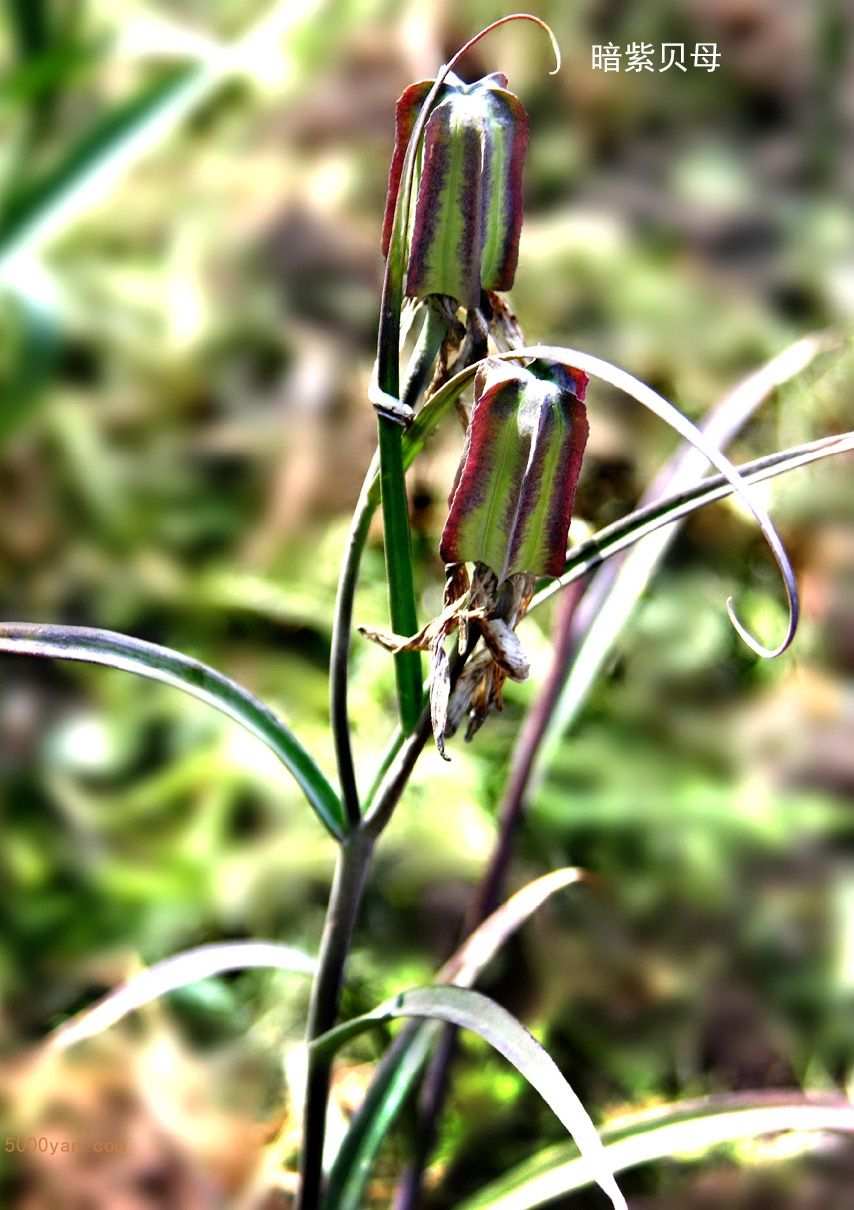
1. Unibract Fritillary: Perennial herb, 15-25 cm tall. Bulb globose or conical, composed of 2 scales, 6-8 cm in diameter. Stem erect, single, glabrous. Lower 1-2 pairs of leaves opposite, upper 1-2 leaves alternate or opposite, sessile, linear or linear-lanceolate, apex acute, not curled. Flower solitary, terminal, deep purple with yellowish-brown small squares; 1 leaf-like bract, apex not curled; perianth segments 6, in 2 whorls, inner 3 obovate-oblong, outer 3 suboblong; nectary slightly protruding or indistinct; stamens 6, about half the length of perianth segments, anthers nearly basifixed, filaments with or without small papillae; stigma 3-lobed, lobes short and spreading. Capsule oblong, with 6 ribs, wings under ribs very narrow. Flowering in June, fruiting in August.
2. Prism-Sand Fritillary: Perennial herb, 17-35 cm tall. Bulb long-ovoid, composed of 2 (-3) scales, diameter 1-2 cm. Leaves alternate, 3-5 (including leaf-like bracts) relatively densely arranged in the middle or upper part of the plant; leaf blades narrowly ovate to ovate-elliptic, apex not curling. Single flower terminal, broadly campanulate, slightly nodding, pale yellow with reddish-brown spots or small squares; inner three tepals slightly longer and wider than outer three, stamens about half the length of tepals, filaments without small papillae; stigma lobes about 1 mm long. Capsule wings on ribs about 1 mm wide, persistent perianth often partially enclosing capsule. Flowering June-July, fruiting August-September.
Habitat and Distribution
1. Fritillaria unibracteata: grows in grasslands at altitudes of 3200-4500 m. Distributed in Sichuan and Qinghai.
2. Ling Sha Bei Mu: grows in rock crevices on shifting sand beaches at an altitude of 3000-4000 m. Distributed in Qinghai, Sichuan, Yunnan, Tibet and other regions.
Harvesting and Processing
Harvested in summer and autumn or after the snow melts; remove fibrous roots, coarse bark, and sediment, then sun-dry or dry at low temperature.
Medicinal Properties
1. Songbei (Fritillaria unibracteata): Ovoid or nearly spherical, 0.3-0.8 cm high, 0.3-0.9 cm in diameter. Surface off-white. Two outer scale leaves, markedly unequal in size, the larger tightly enveloping the smaller, with the uncovered part crescent-shaped, commonly known as "embracing the moon in the bosom"; apex closed, containing a nearly cylindrical central bud with a slightly pointed tip and 1-2 small scale leaves; apex obtuse-rounded or slightly pointed, base flat, slightly concave, with a grayish-brown bulb disk in the center, occasionally with residual fibrous roots. Texture hard and brittle, cross-section white, starchy. Odor: faint; Taste: slightly bitter.
2. Qingbei (Bulbus Fritillariae Cirrhosae, Qingbei type): Subglobose, 0.4-1.4 cm high, 0.4-1.6 cm in diameter. Outer scales in 2 lobes, similar in size, appressed, apex split, containing a central bud and 2-3 small scale leaves and a fine cylindrical remnant stem. 3. Lubei (Bulbus Fritillariae Cirrhosae, Lubei type): Long conical, 0.7-2.5 cm high, 0.5-2.5 cm in diameter. Surface off-white or pale brownish-yellow, some with brown spots. Outer scales in 2 lobes, similar in size, apex split and slightly pointed, base slightly pointed or more obtuse. 4. Cultivated product (Bulbus Fritillariae Cirrhosae, cultivated): Subglobose or short cylindrical, 0.5-2 cm high, 1-2.5 cm in diameter. Surface off-white or pale brownish-yellow, slightly rough, some with pale yellow spots. Outer scales in 2 lobes, similar in size, apex mostly split and relatively flat.
Chemical Constituents
This product mainly contains sipeimine, chuanbeinone, caffeic acid, ferulic acid, songbeinine, chuanbeinone, peiminine, peimisine, baimonidine,β- Sitosterol.
Pharmacology
Expectorant, antitussive; lowers blood pressure; relaxes isolated intestinal smooth muscle; antibacterial, etc.
Properties and Channel Entry
Bitter, sweet, and slightly cold. Enters the Lung and Heart channels.
Functions and Indications
Clears Heat, moistens the Lungs, transforms Phlegm, stops cough, disperses nodules, and reduces abscesses. Used for Lung-Heat dryness cough, dry cough with scant sputum, Yin-deficiency consumptive cough, blood-streaked sputum, scrofula, breast abscess, and Lung abscess.
Dosage and Administration
3-10 g, taken as powder in water, 1-2 g per dose.
Precautions and Contraindications
It is not suitable to use in combination with Chuanwu, processed Chuanwu, Caowu, processed Caowu, and Fuzi.
Prescriptions
1. For cough: *Bulbus Fritillariae Cirrhosae* (large, core removed, stir-fried until yellow) 10 pieces, *Colla Corii Asini* (dry-fried), *Radix Glycyrrhizae* (honey-fried, cut) 15 g each. Grind the above three ingredients into a fine powder. Take 6 g each time, mixed with glutinous rice decoction before bedtime. (From *Shengji Zonglu*, Beimu Powder) 2. For whooping cough: *Herba Hedyotidis Diffusae* 5 g, *Bulbus Fritillariae Cirrhosae* 10 g, *Radix Glycyrrhizae* 10 g. Grind the above three ingredients, sieve, and mix evenly. Oral administration, 1.5-3 g each time, 3 times daily. [From *Journal of Anhui College of Traditional Chinese Medicine* 1984, 3(4):43] 3. For hematemesis and epistaxis, occurring intermittently, all due to Heart channel heat accumulation: *Bulbus Fritillariae Cirrhosae* (roasted until yellow) 30 g. Grind into a fine powder, take 6 g with warm water at any time. (From *Shenghui Fang*) 4. For acute mastitis: *Bulbus Fritillariae Cirrhosae* and *Flos Lonicerae Japonicae* 60 g each. Grind into a fine powder, take 9 g each time, mixed with good wine, taken after meals. (From *Puji Fang*) 5. For promoting lactation: *Concha Ostreae*, *Rhizoma Anemarrhenae*, *Bulbus Fritillariae Cirrhosae*. Grind the three ingredients into a fine powder, mix with pig trotter soup and take. (From *Tangye Bencao*, Sanmu Powder)