Pinyin: Chuanniuxi
Aliases
Niuxi, Jia Niuxi, Long Niuxi
Source
Amaranthaceae plant Cyathula officinalisCyathula officinalisDried root of Kuan.
Botanical Description
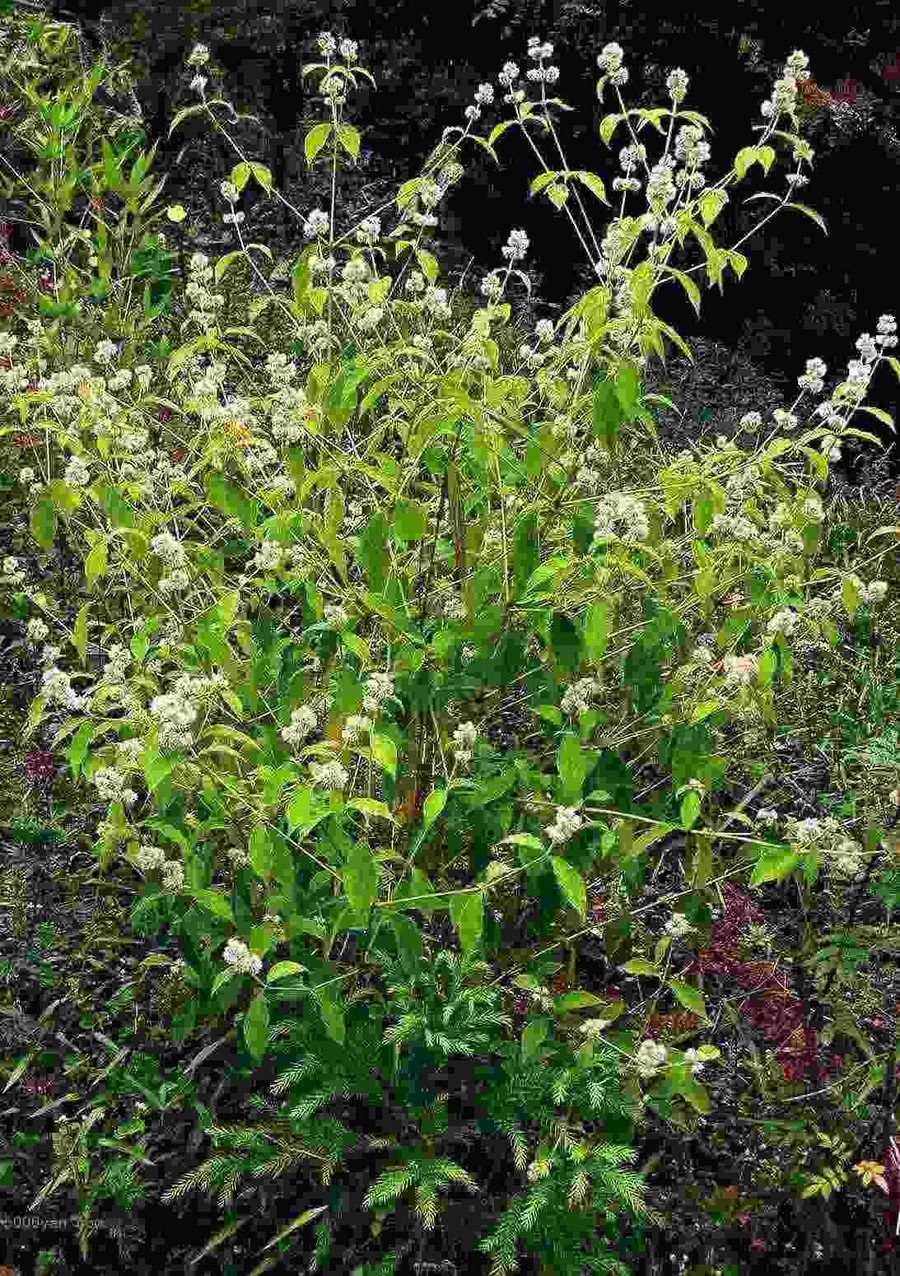
Herbaceous perennial, 50-100 cm tall. Main root cylindrical, bark nearly white. Stem slightly quadrangular, much branched, sparsely covered with long coarse hairs. Leaves opposite; leaf blades elliptic or narrowly elliptic, rarely obovate, apex acuminate or caudate, base cuneate or broadly cuneate, margin entire, adaxially appressed with long coarse hairs, abaxially more densely hairy. Compound cymes densely aggregated into spherical flower clusters; flower clusters numerous, pale green, nearly white when dry, oppositely arranged on the inflorescence axis at branch tips, densely packed or spaced 2-3 cm apart; compound cymes with 3-6 orders of branching; cymes bisexual, with a central flower and sterile lateral flowers; bracts ovate, shiny, apex with awns or hooks; sterile flowers with perianth segments transformed into hooked, rigid awns; bisexual flowers with lanceolate perianth segments, apex spinose-acuminate, the inner 3 segments narrower; filament bases densely covered with nodose tufted hairs, staminodes rectangular, about half as wide as long, apex shallowly dentate; ovary cylindrical or obovoid, style persistent, stigma capitate. Utricle ellipsoid or obovoid, pale yellow, enclosed within the persistent perianth. Seeds ellipsoid, lenticular, reddish, shiny. Flowering June-July, fruiting August-September.
Habitat and Distribution
It grows in areas at an altitude of 500 m or above. Mainly produced in Sichuan, Yunnan, and Guizhou. In recent years, it has been cultivated in Shaanxi, Hubei, and Hunan.
Harvesting and Processing
Harvested in autumn and winter, remove the rhizome head, fibrous roots, and sediment, bake or sun-dry to half-dry, pile up to allow moisture to redistribute, then bake or sun-dry until completely dry.
Medicinal Properties
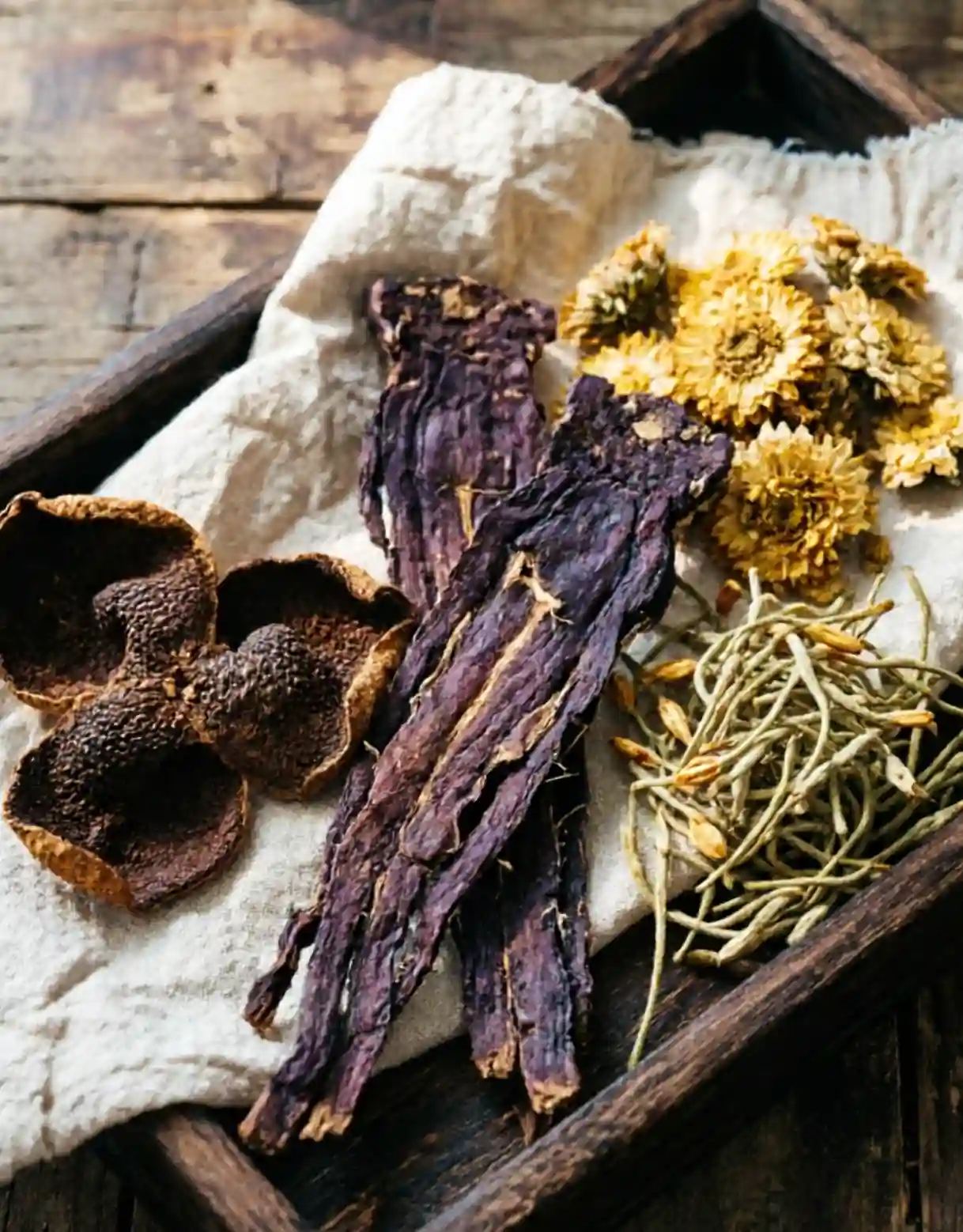
This product is nearly cylindrical, slightly twisted, tapering downward or with a few branches, 30-60 cm long, 0.5-3 cm in diameter. The surface is yellow-brown or gray-brown, with longitudinal wrinkles, rootlet scars, and numerous transverse, elongated lenticel-like protrusions. The texture is tough, not easily broken; the cut surface is pale yellow or brown-yellow, with dotted vascular bundles arranged in several concentric rings. Odor: faint; Taste: sweet.
Chemical Constituents
This product mainly contains cyasterone, ferulic acid, and Achyranthes polysaccharides.β- Ecdysterone and other constituents.
Pharmacology
Anti-fertility; cholagogic effect; lowers lipids; promotes blood circulation; enhances immune function; promotes weight gain and hepatic/renal protein synthesis; relaxes the uterus in guinea pigs and contracts the uterus in rabbits.
Properties and Channel Entry
Sweet, slightly bitter, neutral. Enters the Liver and Kidney channels.
Functions and Indications
Expels stasis, unblocks the menses, facilitates joint movement, and promotes urination to treat stranguria. Used for amenorrhea and abdominal masses, retained placenta, traumatic injuries, wind-damp painful obstruction (bi) disorder, lower limb atrophy and muscle spasms, hematuria, and blood stranguria.
Dosage and Administration
Dosage: 6-10 g decocted in water for oral administration, or made into pills or powder, or steeped in wine.
Precautions and Contraindications
Contraindicated for pregnant women and those with menorrhagia (excessive menstruation).
Prescriptions
1. For dysmenorrhea and amenorrhea due to blood stasis: Chuan Niuxi 10 g, Danggui 12 g, Honghua 6 g, Xiangfu 10 g, Yimucao 30 g. Decoct in water and take orally. (Sichuan Chinese Materia Medica, 1979) 2. For Kaschin-Beck disease (big bone disease): Chuan Niuxi 250 g, processed Caowu 250 g, processed Chuanwu 250 g, Honghua 500 g. Mix into a powder. Take 1 g per dose, 3 times daily, with 40 days as one treatment course. (National Compendium of Chinese Herbal Medicine) 3. For sequelae of infantile paralysis: Chuan Niuxi 9 g, Tubicchong (7 pieces), Maqianzi (fried in oil until yellow) 1 g. Grind together into a fine powder and divide into 7 packets. Take 1 packet before bed each night, with rice wine (Huangjiu). (National Compendium of Chinese Herbal Medicine) 4. For painful urination, hematuria, or stabbing pain from urinary stones: Chuan Niuxi 30 g, water 2 cups, decoct to 1 cup, take warm. (Compendium of Materia Medica, quoting Zhizhi Fang) 5. For heat stranguria (painful urination with heat): Chuan Niuxi 12 g, Danggui 9 g, Huangqin 9 g, Zhizi 9 g. Decoct in water and take orally. (Hunan Materia Medica)