Pinyin: Bailian
Aliases
E Bao Dan, Jian Zhong Xiao, Ye Hong Shu.
Source
1. For pneumonia: Renshen 6 g, decoct in water and take orally.Ampelopsis japonicaDried root tuber of (Thunb.) Makino.
Botanical Description
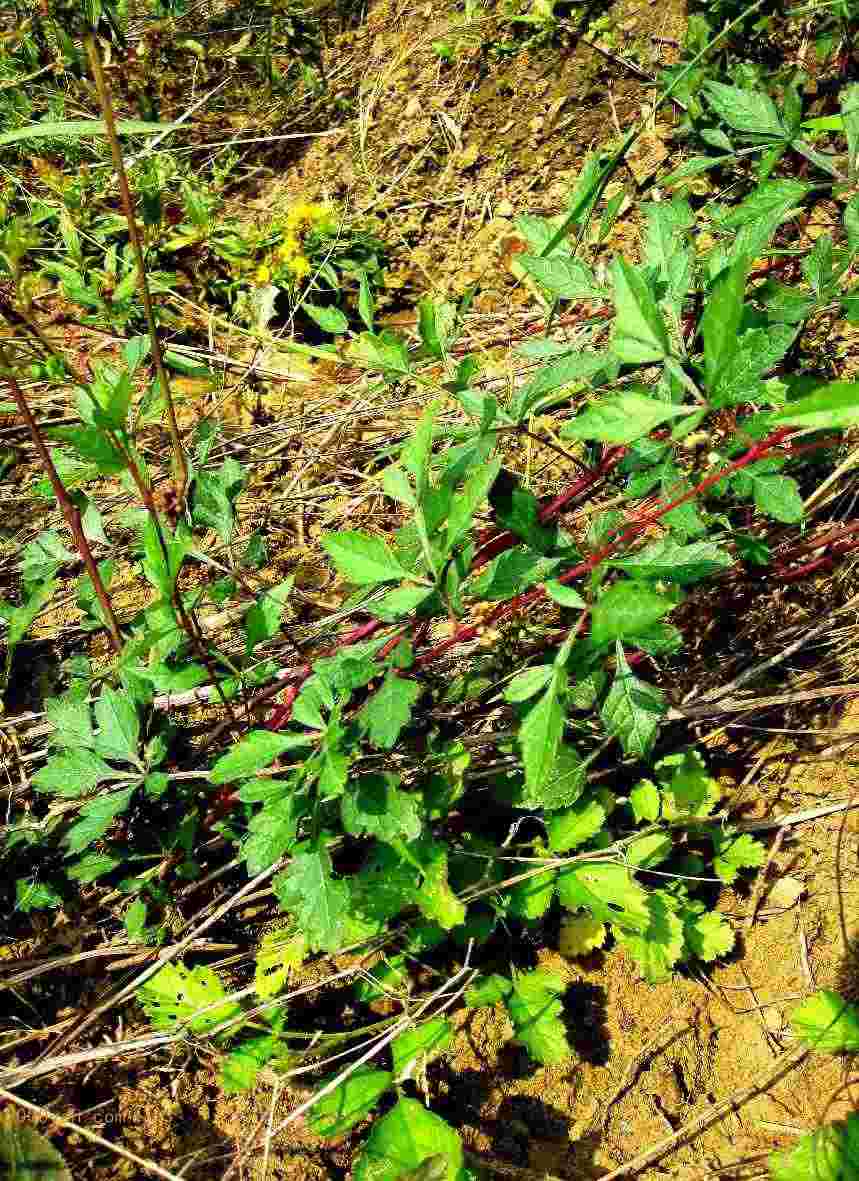
Deciduous climbing woody vine, approximately 1 m long. Root tubers stout, fleshy, ovoid, oblong, or long fusiform, dark brownish-brown, clustered in groups. Stems much-branched, young branches with light purple tint, glabrous, finely striate; tendrils opposite to leaves. Palmately compound leaves alternate; petiole 3-5 cm long, slightly purplish, glabrous or finely hairy; leaf blade 6-10 cm long, 7-12 cm wide; leaflets 3-5, pinnately divided or pinnatifid, lobes ovate to elliptic-ovate or ovate-lanceolate, apex acuminate, base cuneate, margin deeply serrate or incised, middle lobe longest, lateral lobes smaller, rachis with broad wings, lobe bases articulate, both surfaces glabrous. Cymes small, opposite to leaves, peduncle 3-8 cm long, slender, often twining; flowers small, yellowish-green; calyx 5-lobed; petals and stamens 5 each; disc margin slightly divided. Berry globose, about 6 mm in diameter, white or blue when ripe, with pinhole-like pits. Flowering May-June, fruiting September-October.
Habitat and Distribution
It grows in mountainous areas, barren slopes, and shrub forests, and is also cultivated
Harvesting and Processing
Harvested in spring and autumn, remove soil and fine roots, cut into longitudinal or oblique slices, and sun-dry.
Medicinal Properties
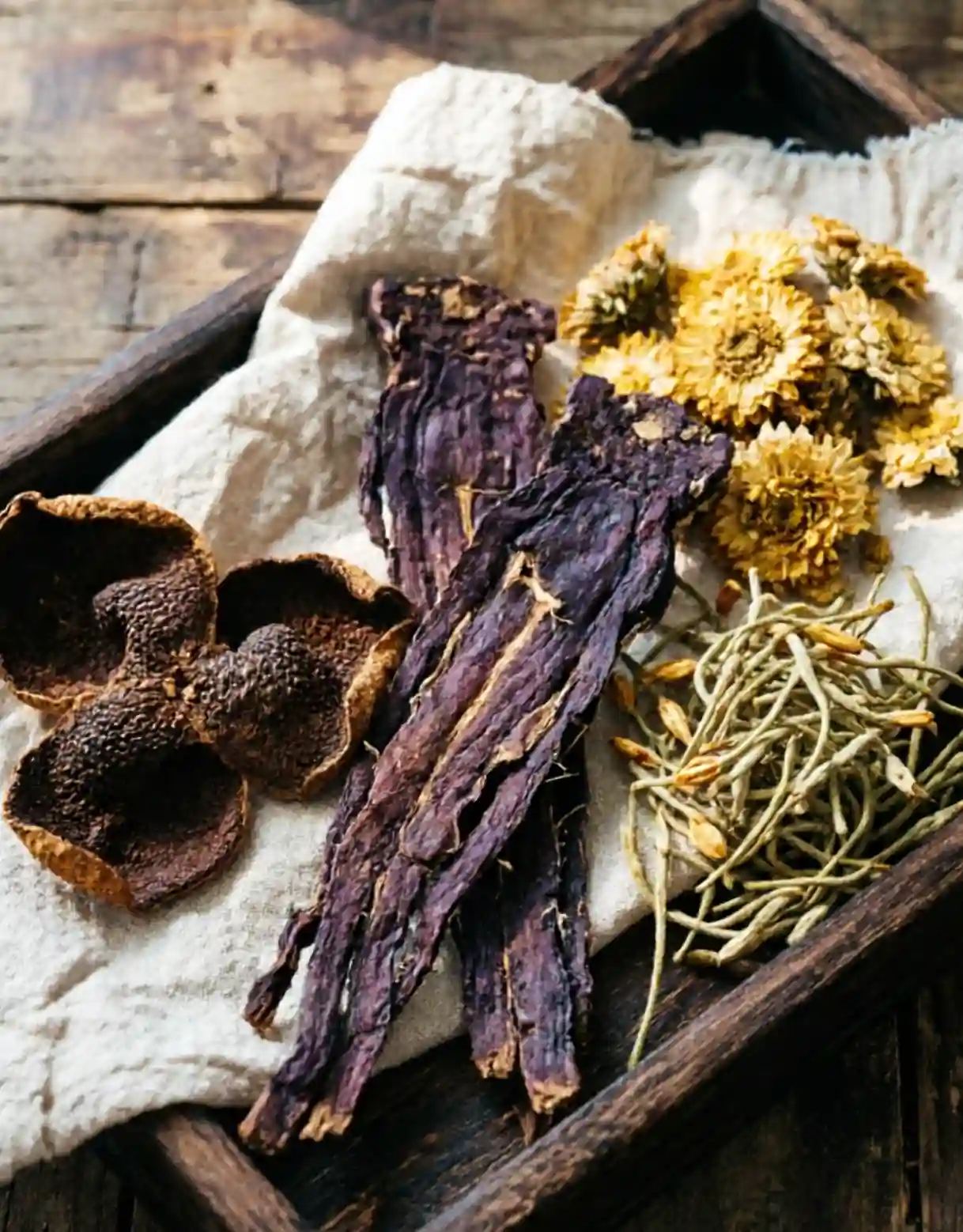
The longitudinal slices are oblong or nearly fusiform, 4-10 cm long and 1-2 cm in diameter. The cut surface often curls inward at the edges, with a prominent ridge in the center. The outer bark is reddish-brown or reddish-brown, with longitudinal wrinkles, fine transverse striations, and transverse elongated lenticels; it easily peels off in layers, revealing a light reddish-brown color underneath. The oblique slices are ovoid, 2.5-5 cm long and 2-3 cm wide. The cut surface is off-white or light reddish-brown, showing radial striations, with thicker edges that are slightly raised or gently curved. The texture is light, hard and brittle, breaking easily with dust flying out when snapped. Odor: faint; Taste: sweet.
Chemical Constituents
This product contains tartaric acid, fumaric acid, quercetin, resveratrol, emodin,α- Beta-sitosterol, protocatechuic acid, etc.
Pharmacology
Has antibacterial, anticancer, and analgesic effects.
Properties and Channel Entry
Bitter, slightly cold. Enters the Heart and Stomach channels.
Functions and Indications
Clears Heat and resolves toxicity, disperses abscesses and dissipates nodules, constricts sores and generates tissue. Used for deep-rooted carbuncles and back abscesses, furuncles, scrofula, and burns and scalds.
Dosage and Administration
5-10 g. For external use, apply an appropriate amount, decoct and wash the affected area or grind into a very fine powder for topical application.
Precautions and Contraindications
Contraindicated in cases of Spleen and Stomach deficiency-cold and those without excess Fire; use with caution during pregnancy. Should not be used in combination with Chuanwu, processed Chuanwu, Caowu, processed Caowu, or Fuzi.
Prescriptions
1. For burns and scalds: Bai Lian powder, apply topically. (from *Beiji Fang*) 2. For throat obstruction: Bai Lian and Bai Zhi in equal parts, grind into powder, take 6 g with water orally. (from *Shenghui Fang*) 3. For Damp-Heat leukorrhea: Bai Lian and Cang Zhu, 6 g each, grind into fine powder, take 3 g per dose, 2 times daily, with white sugar water. (from *National Compendium of Chinese Herbal Medicine*) 4. For inguinal hernia: Bai Lian 30 g, decoct in water, add white sugar and take. (from *Qingdao Chinese Herbal Medicine Manual*) 5. For non-healing sores: Bai Lian, Bai Ji, and Luo Shi Teng, 15 g each (dried), grind into fine powder, sprinkle dry onto the sore. (from *Jifeng Puji Fang* Bai Lian San)