Pinyin: Tiankuizi
Aliases
Zibeitiankuizi, Didinzi, Tiankuigen.
Source
Ranunculaceae plant TiankuiSemiaquilegia adoxoidesDried root tuber of (DC.) Makino.
Botanical Description
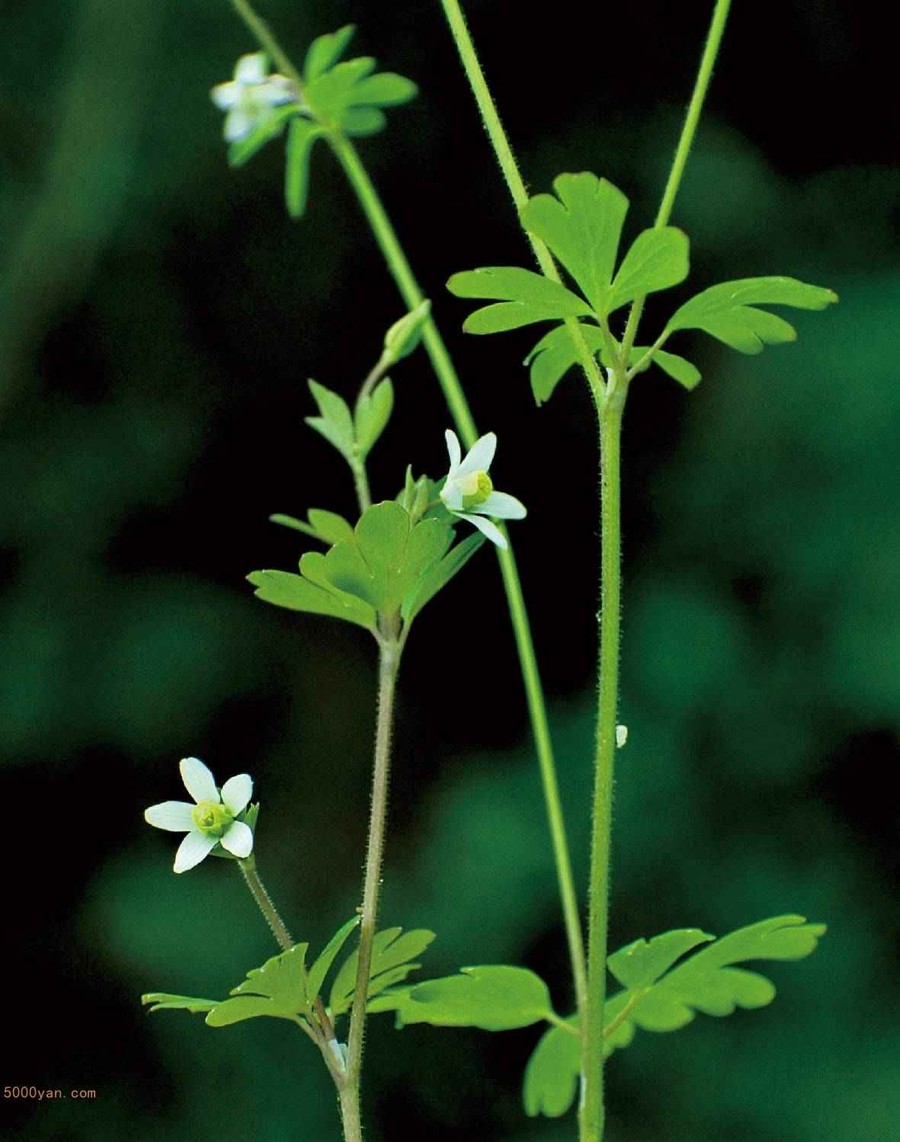
A perennial small herb, 10-30 cm tall. The tuberous root has a brownish-black outer bark. The stem is erect, 1-3 in number, branched in the upper part, sparsely covered with white soft hairs. Basal leaves are trifoliate; the petiole base expands into a sheath; the leaf blade is ovate-circular or reniform in outline; leaflets are fan-shaped-rhombic or obovate-rhombic, 3-parted, with the deep lobes further divided into 2-3 rounded-toothed incised lobes, glabrous on both surfaces, often purplish beneath; stem leaves are smaller, alternate, with shorter petioles. Inflorescence is a monochasial or dichasial cyme; pedicels are covered with fine white soft hairs; bracts and bracteoles are leaf-like, 3-lobed or unlobed; flowers are bisexual, small, 4-6 mm in diameter; sepals 5, petaloid, narrowly elliptic, white, often tinged with pale purple, apex rounded-obtuse; petals 5, spatulate, apex nearly truncate, base raised and pouch-like; stamens 8-14, filaments widened below, anthers broadly elliptic, yellow; staminodes 2, linear-lanceolate, located inside the stamens, white and membranous, nearly as long as the filaments; carpels 3-4, style short, apex reflexed outward, glabrous. Follicles 3-4, with transverse veins on the surface, apex with a small, fine beak. Seeds numerous, ovoid-elliptic, dark brown, with small tuberculate protrusions on the surface. Flowering period is March to April, fruiting period is April to May.
Habitat and Distribution
It grows in sparse forests, grassy areas, beside ditches and roads, or in relatively shady places in valleys. It is distributed in Shaanxi, Jiangsu, Anhui, Zhejiang, Jiangxi, Fujian, Hubei, Hunan, Guangxi, Sichuan, and Guizhou.
Harvesting and Processing
Harvested in early summer, washed clean, dried, and the fibrous roots removed.
Medicinal Properties
This product is irregularly short-cylindrical, fusiform, or lump-shaped, slightly curved, 1-3 cm long, and 0.5-1 cm in diameter. The surface is dark brown to gray-black, with irregular wrinkles and fibrous roots or root scars. The apex often has remnants of stems and leaves, covered by several layers of yellowish-brown sheath-like scales. The texture is relatively soft and easily broken; the bark in the cross-section is whitish, while the wood is yellowish-white or yellowish-brown, slightly radial. Odor: faint; Taste: sweet, slightly bitter and acrid.
Chemical Constituents
This product contains quercetin, malic acid, chlorogenic acid, aconitic acid, esculetin, succinic acid, etc.
Properties and Channel Entry
Sweet, bitter, and cold. Enters the Liver and Stomach channels.
Functions and Indications
Clears Heat, resolves toxicity, reduces swelling, and dissipates masses. Used for carbuncles, furuncles, breast abscesses, scrofula, and snake or insect bites.
Dosage and Administration
Oral: decoct in water, 3-9 g; or grind into powder, 1.5-3 g; or steep in wine. For external use, apply appropriate amount, pound for topical application, or pound to extract juice for eye drops.
Precautions and Contraindications
Contraindicated in patients with Spleen and Stomach deficiency cold.
Prescriptions
1. For stomach heat with pain: Tiankuizi (Semiaquilegiae Radix) 6 g, mash or chew, swallow with boiling water. (Guiyang Folk Herbal Medicine) 2. For pulmonary tuberculosis: Tiankuizi 120 g, place in one large pig's stomach, boil until done, remove residue, eat continuously for 3 stomachs. (Guiyang Folk Herbal Medicine) 3. For lumbar soreness and pain: Zibei Tiankui (Semiaquilegiae Radix) tuberous root 13 pieces (or large tuberous root), mash for external application or swallow. (Zhejiang Folk Herbal Medicine) 4. For scrofula and breast cancer: Tiankuizi tuberous root 1.5 g, add Xiangbei (Fritillariae Thunbergii Bulbus) 6-9 g, calcined Muli (Ostreae Concha) 9-12 g, Gancao (Glycyrrhizae Radix et Rhizoma) 3 g, decoct together and take several times. (Zhejiang Folk Herbal Medicine) 5. For intestinal adhesion: Tiankuizi 15 g, pork lean meat 60 g. Stew in water until the meat is done, eat the meat and drink the soup. (Anhui Traditional Chinese Medicine)